
As I’ve said, I don’t pay much attention to whatever is fashionable these days in “audio,” which means: mechanical reproduction of music in the home. It doesn’t interest me much. But, to give some idea of how we got to this condition, I thought it would be helpful to review the history of “audio” since about 1950.
Before 1950 were the Radio Days. Before the introduction of the Long Playing Record in the late 1940s, the best reproduced music was available from live radio broadcast. “Audio” was one with radio, basically a radio with an ambitious speaker. With the LP, and better turntables to play them, “audio” divorced from radio.
Here is another excellent account of the “history of HiFi,” here.
1950s
The 1950s were still the mono era, but with LP records. It was a Golden Age, of big beautiful horn-based speakers, including the majestic Klipschorn. You could have a big speaker, because you only needed one of them, which means you didn’t have to spend double on two speakers, or half on each speaker. Also, you could put them in a corner, out of the way (this is actually necessary for the corner-based horn speaker of the Klipschorn), and you didn’t have to try to set up two speakers in some kind of symmetric fashion. So, they could be as big as a refrigerator, and it didn’t bother people much. Probably the greatest artifact of this era was the Tannoy Autograph, which also was designed to go in the corner.
Here is one that someone built new:
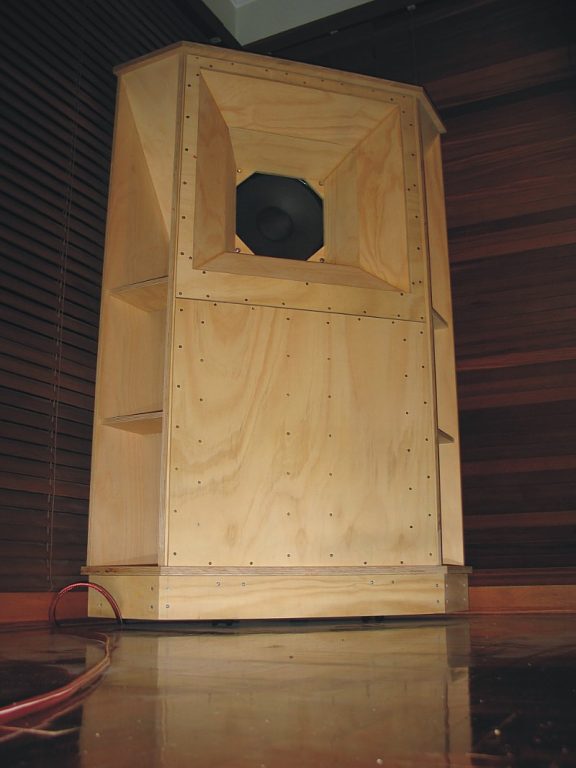
You can see the big horn exits on the sides. The cone in the middle is a 15″ driver, to give an idea of the size.
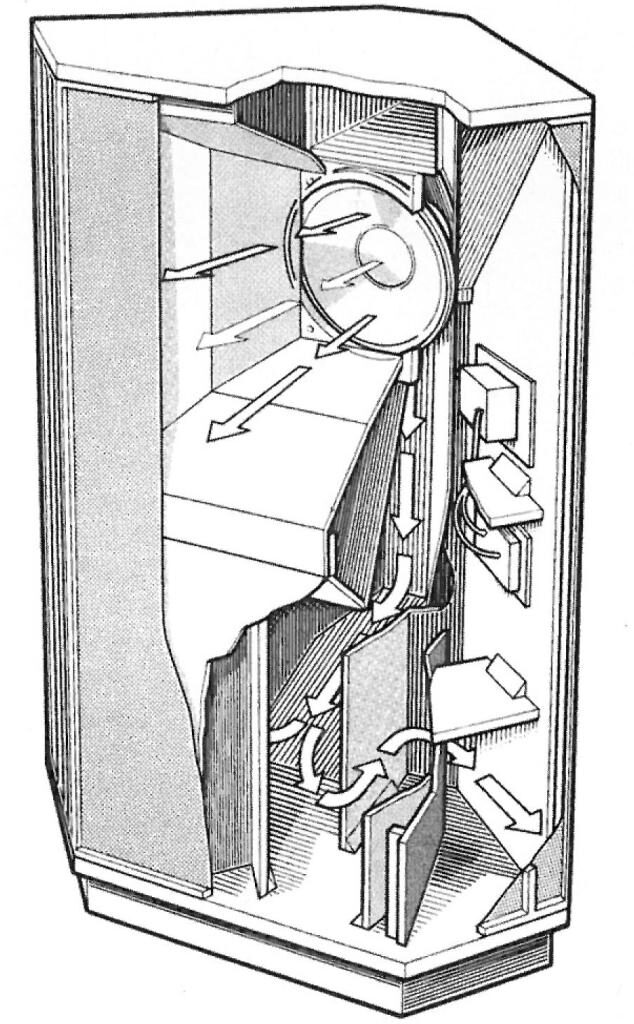
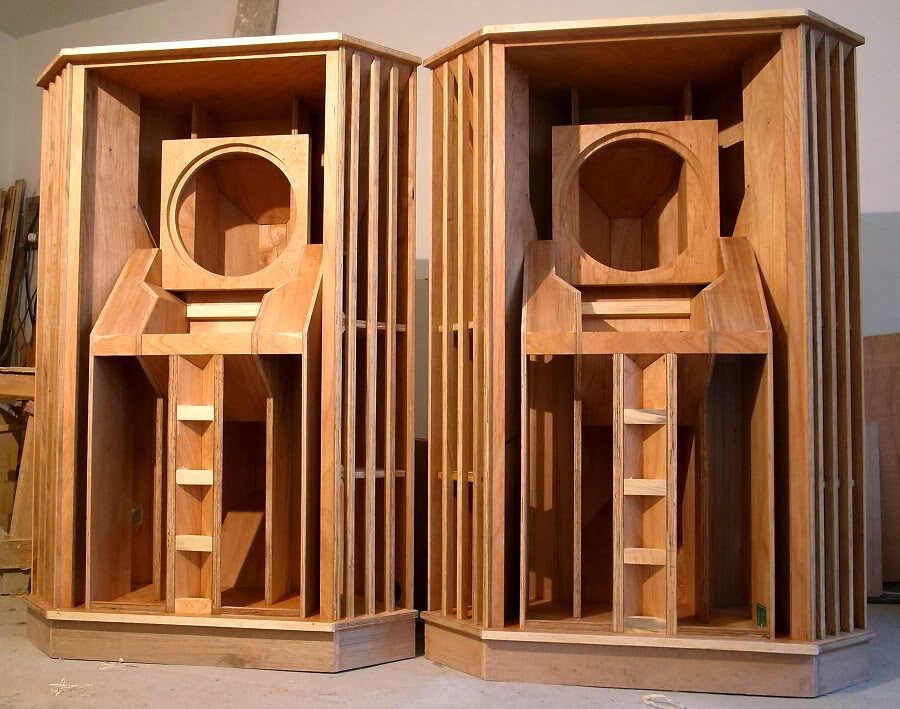
This is not just a box, it is a big folded backload horn.
The 1920s and 1930s were the era of Directly Heated Triodes, interstage transformers, Class A operation, and no feedback. This sounded wonderful. But, not much power. The standard 45 DHT of the time, common in consumer electronics, made a big 1.5 watts of power — 3 watts in push-pull. The 300B of 1938 made 8 watts, but was originally available only in commercial equipment. Speakers needed to be very, very efficient, like the 103db-ish Klipschorn and Tannoy Autograph. Even then, you could only make about 106db peaks with 2 watts of power, and you didn’t have two speakers (adding about 3db). This is good, but still limited.
In the 1940s, there were big advancements in vacuum tube electronics, for all kinds of wartime purposes such as radar. When these engineers went back to civilian jobs, they took what they learned and applied them to consumer audio electronics. This was the era of the Williamson amplifier. Driver tubes were commonly 9-pin 12 volt tubes such as the 12ax7 and 12au7. Power tubes were power pentodes including the 6550, EL34 and KT88. Simple Class A operation gave way to Class AB, which required negative feedback to work properly. But, add it all together, and you were making 20-60 watts with your amplifiers, not 4 watts.
These tubes were cheaper and more powerful than the troublesome DHTs of the 1930s and the octal signal tubes of the 1940s. But, they didn’t sound as good. It didn’t matter too much, because their bad sound was covered up by copious negative feedback.
1960s
In the 1960s, stereo came in. Now those big corner horns were not so popular, because you had to spend 2x to have two of them, having two huge things in your living room wasn’t so hot, and you had to somehow find a way to balance the channels. The corner horn gave way to the box speaker that could be arranged anywhere in the room. The Klipsch Cornwall was an example of this era. The name originally meant that it could be placed against a corner or wall (they were still big so people wanted them against the sides).
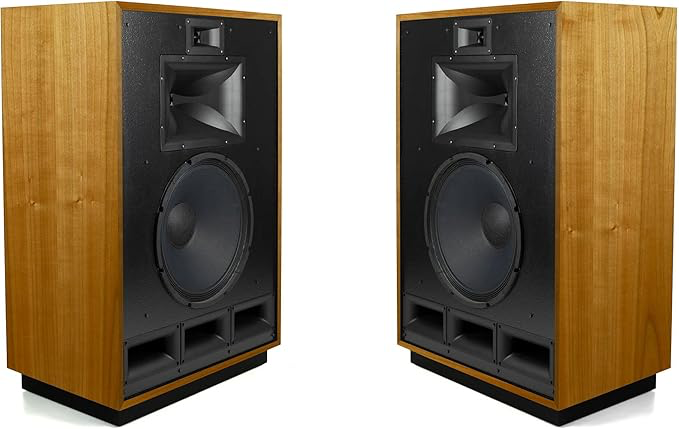
Efficiency was still high, around 98db. But, that is still a good 5db or so less than the Klipschorn. Basically, it would require about 4x as much power to make the same sound output. But, we had power now, from those 20-40 watt pentode amplifiers. Also, it was smaller and cheaper, so you could have two of them, and it wasn’t stupidly expensive or stupidly large.
With more powerful amplifiers, you could even drive “acoustic suspension” speakers, the early days of today’s cone-and-dome box speakers. Here is the Acoustic Research AR-1, originally from 1954:
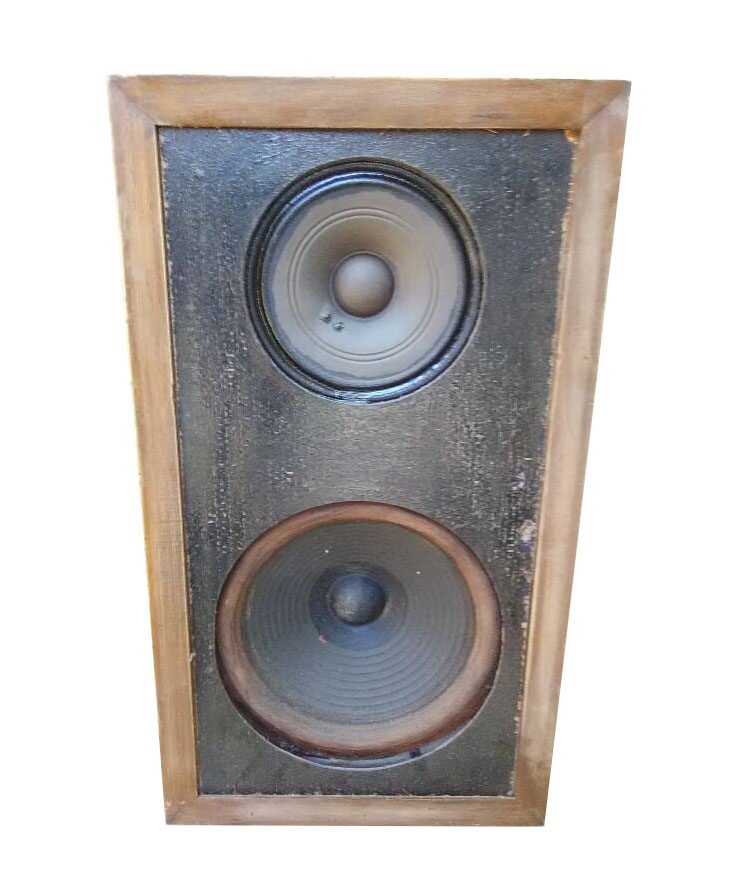
It’s basically an 8″ fullrange driver — looks like an Altec 755C — with some bass support. The Altecs, which are now legendary, at the time were basically designed for public address use. You might have said the pledge of allegiance in elementary school with a 755C.
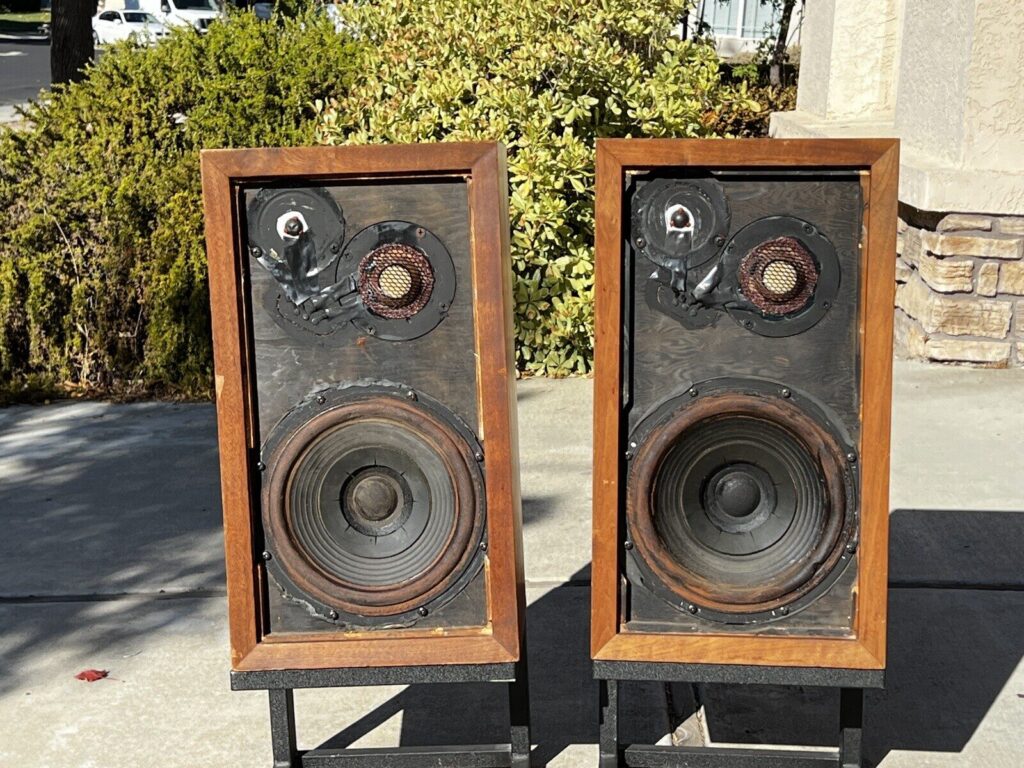
By the AR-3, we have the familiar cones and domes that haven’t changed much today.
These boxes were small, and cheap — much cheaper than the hulking Cornwall. Of course they were very popular, and brought audio to the masses. However, they were very inefficient, with typical efficiency of a piteous 83db — about 15db less than the Cornwall-type speaker. In other words, it required 30x more power to make the same sound output as the Cornwall, and 100x more power to make the same sound output as the Klipschorn. This was still OK, using the 40 watt pentode amplifiers of the time. You would have a peak output of about 16db (40 watts) + 83db or 99db, which translates into a max listening level of about 89 db. It was enough, but small.
1970s
During the 1970s, LP record reproduction got really good. This was the era of commercial radio stations playing LP records, which meant that there were companies making pro-level turntables for radio stations. The pinnacle of this era was the Technics SP-10 turntable, which some think was the best turntable ever made even until about 15 years ago. At a lower price point was the Technics SL-1200, which people were still enjoying 30 years later.
Transistors displaced vacuum tubes in the 1970s. These early transistor amplifiers really sucked — they had a habit of self-destructing due to uncontrolled positive feedback loops. They would literally catch on fire. So, you can imagine how good they sounded … har. But, they were cheap. And they made big power — unimaginably big, compared to the vacuum tube era. At the forefront was Phase Linear, with transistor amplifiers making hundreds of watts, which even Wikipedia says was used to drive the little box speakers made by Acoustic Research and others.
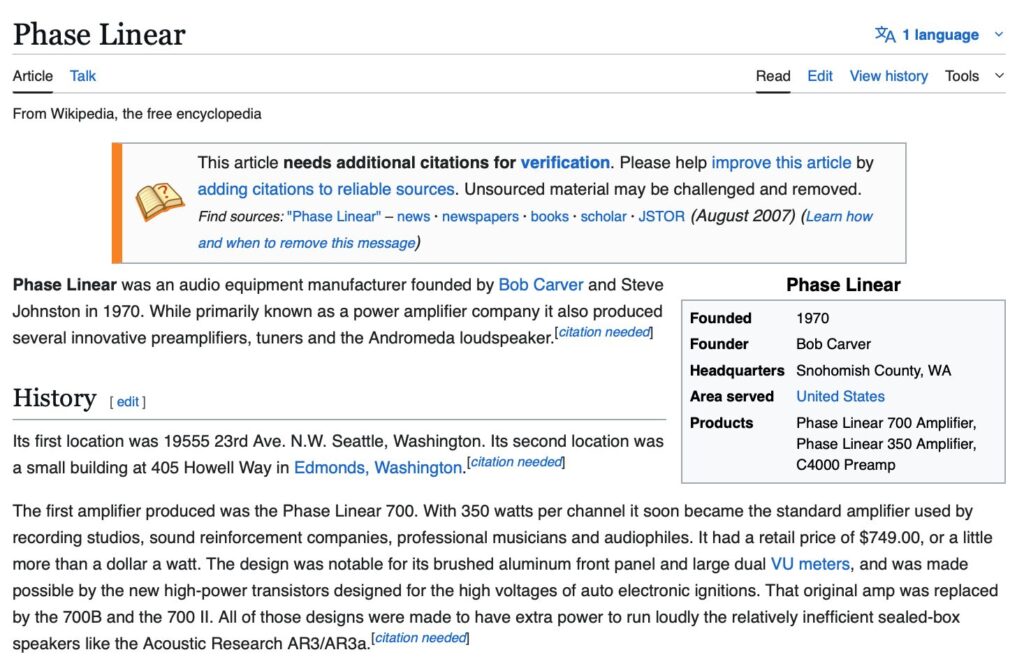
While people still love the SP10 turntables of the 1970s, the transistor amplifiers of the 1970s were total crap, in terms of sound quality.
But, you couldn’t hear this easily with the inefficient cone speakers of the time. If you hooked up a big horn system — like that Tannoy Autograph — to a Phase Linear amplifier, it was complete audio vomit. (If you are not quite sure what I mean by “audio vomit,” think of a wine by Franzia.) The result was that horn speakers became even more unpopular, although they were already unpopular due to their size and cost.
1980s
By the 1980s, the 87db cones-and-domes-in-a-box became the standard for “audiophiles.” They improved dramatically from the early experiments of the 1960s. Sometimes, people used even-less-efficient (82db/w/m) and harder-to-drive (sub-3 ohm impedances) planar magnetic and ribbon speakers, requiring even bigger transistor amplifiers. These amplifiers got a lot better. At least, they didn’t self-destruct anymore. Good! This was also the era of CDs, and cassette tapes. These were convenient … but they didn’t sound as good as LPs. But who cared? You wanted something that you could play in your car, or on a Walkman. Early digital really, really sucked. It was not in the same universe as the very good vinyl reproduction available in those days. But, most people did not have very good vinyl reproduction. Most people had some kind of total crap record player. CDs were a lot better than those. And so were cassettes. And you could record your own cassettes. This was the “mix tape” era.
So, if you’re following along, we have a) speakers that kinda suck; b) amplifiers that suck; c) CDs and cassettes that suck. But, they were cheap and convenient. Audiophiles tended to follow these consumer trends. They would begin with a midfi Japanese receiver and some boxes from Boston Acoustics or Polk Audio, and then look to upgrade to a better receiver and better boxes. Nobody was telling them, “maybe you should try a Tannoy Autograph.”
But, there was a very small movement, mostly in Japan and France, that revived those old speakers, and also the commercial theater gear of the 1950s that was then being replaced by “THX Certified!!!” systems in movie theaters to reproduce the explosions in The Return of the Jedi.
They took these old speakers, and then combined them with amplifiers inspired by the electronics of the 1930s, out of the huge junkpile of parts left over from the abandonment of vacuum tubes in the 1970s. The 300B tubes that were unobtanium for the 1940s audiophile were found on the surplus junkpile. The 845s that were made for commercial radio stations became available for the home hobbyist. The giant 1930s Western Electric speakers that the most fuddy-duddy old movie theaters were literally sending to the dump were quietly snatched up by Audio Gnomes and sent off to Asia.
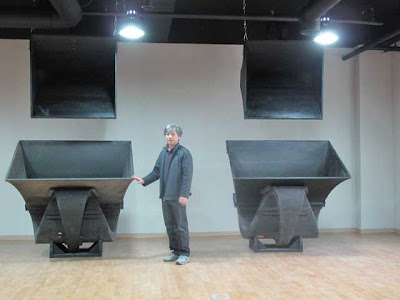
From the Silbatone collection, in South Korea.
This was something new — these speakers didn’t exist in the 1930s, and these electronics mostly didn’t exist in the pentode-driven 1950s. And, they had turntables from the 1970s. And it was wonderful — compared to what was being touted as “the best ever!!!” in Stereophile Magazine in the 1980s.
Mostly in places like Japan, among commercial products, there were still a few fans of big horn speakers, buying products like the JBL Everest, and playing them probably with the 1980s version of the 1950s Williamson pentode amplifier, from makers like VTL or McIntosh. The Tannoy Westminster of 1982 and the Westminster Royal of 1987 were basically updated versions of the Tannoy Autograph, in a rectangular box that did not require corner placement, so they could be used in stereo. These are still loved today. I own a phono cartridge from around 1983, from Micro Seiki, that has silver wire and alnico magnets — an artifact of what was on Japanese audiophiles’ minds in those days, while Americans were trying to keep their 300W transistor amps from self-destructing. I somehow acquired this at the age of 15, which is destiny I suppose.
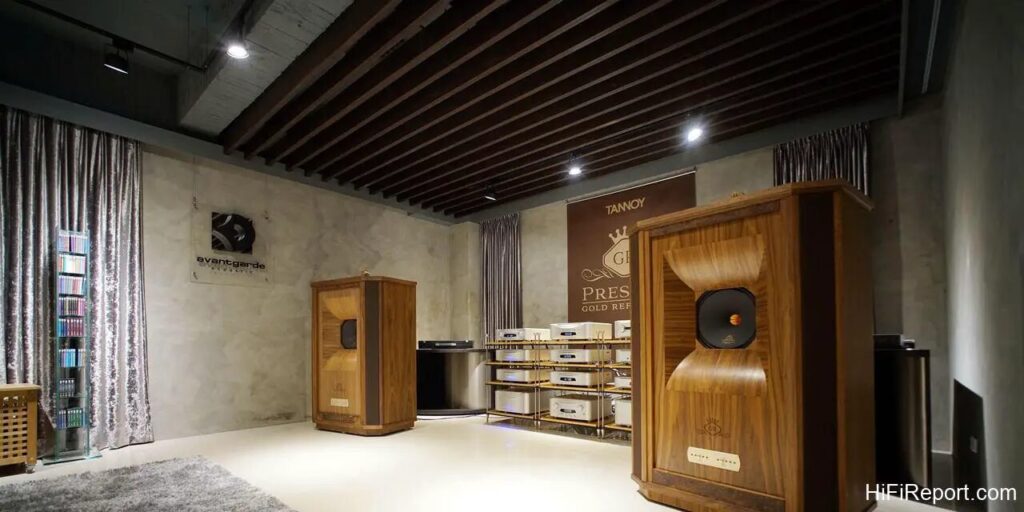
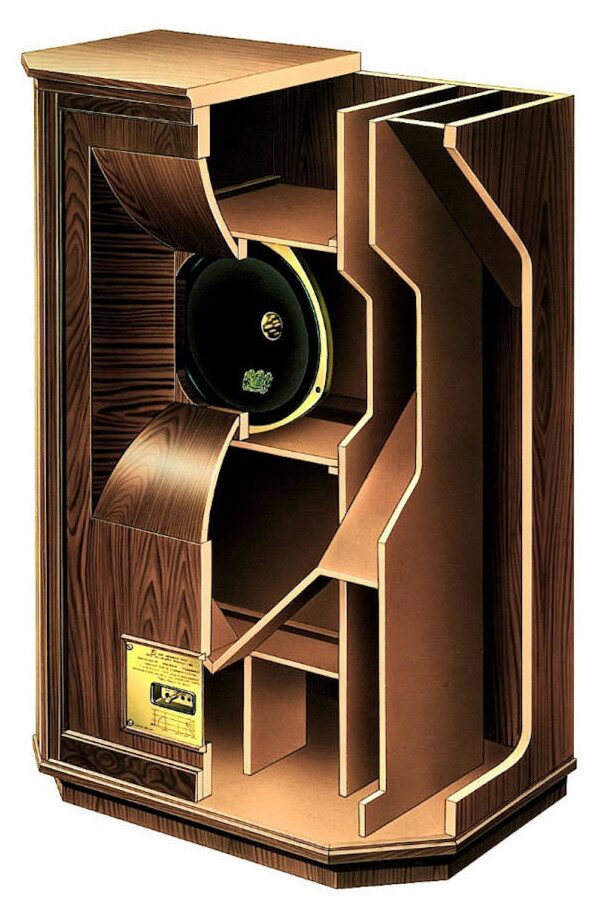
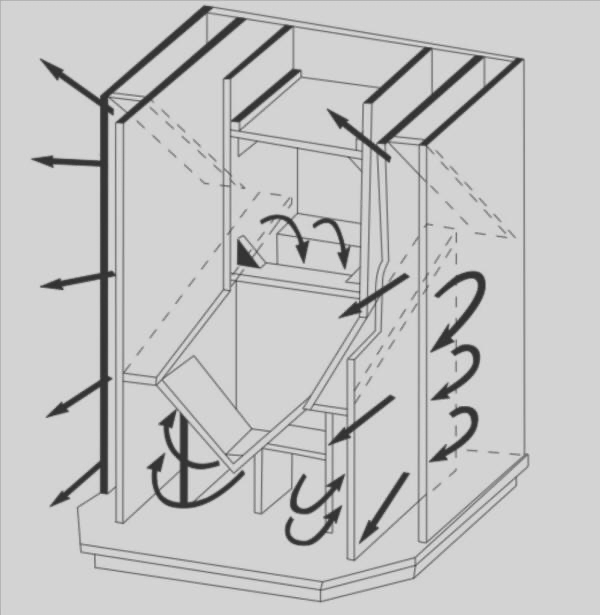
Among the commercial products of this era, about the only one that people are still excited about listening to today was 1989’s Audio Note Ongaku amplifier — still to this day a reference for great sound. The Ongaku was complete crazy-town, with transformers wound with pure silver, and four vacuum-tube rectifiers in a diode bridge.
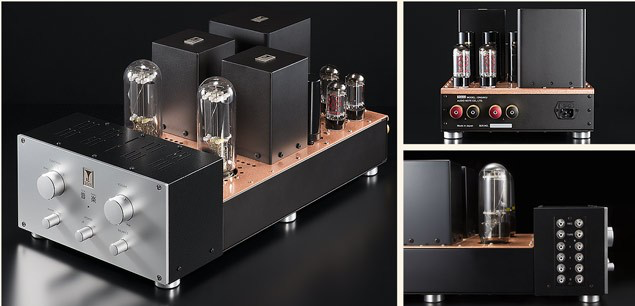
You can buy a used pair of Westminster Royale speakers for about $25,000, and an Ongaku for about the same, but you will have to look hard for them. This would represent among the greatest accomplishments ever achieved in the audio realm, up to the present day, and you can just plug it in and enjoy. $50K is big money, but you could listen to it for five years and then sell it for more than you bought it for. Or, you can buy a Mercedes sedan — or a big pickup from Chevrolet — and lose $50K (or more) to depreciation in five years. Get the Toyota and buy these speakers, and amplifiers.
1990s
The transistor amplifiers of the 1980s continued into the 1990s, with modest refinements. Krell or Accuphase represented “the best” of this era. Cones-in-a-box speakers also improved, with new materials science, and new engineering tools. The Thiele-Small breakthroughs of the 1970s led to cheap computerized frequency response, MLSSA graphs, and one-click computer optimization of passive crossovers. In the 1990s, you could say that the basic transistor amplifier, and cones-in-a-box speaker, was largely perfected, from an engineering standpoint. Stuff you could measure, like frequency response and total harmonic distortion, was optimized. For the mainstream, this was — again — an era of cheaper and more convenient. The big and relatively expensive “luxury Japanese receiver” of the 1980s was reproduced in cheap little plastic component stacks that, for some reason, I always associate with bars on the beach in Thailand (wonder why). This was the era when “monolithic power amplifiers” like the LM1875 and LM3875, a single integrated chip costing a few bucks each, could produce pretty decent sound for the masses. CD sound got a lot better — I still enjoy listening to one of Sony’s better CD decks from the late 1990s — but was still notably behind compared to an ambitious vinyl rig.
But, after all this engineering optimization, people noticed that the results did not sound good. They would take restored Dynaco Stereo 70 amplifier from the 1960s, hook it up to an Altec Flamenco or some old thing that you could buy at a garage sale after someone died or moved to a retirement home, with one of the top-quality vinyl rigs of the 1970s/1980s that people were throwing out by the 1990s in favor of CDs (a Linn Sondek LP12 or Technics SL-1200), and it would sound good, in a satisfying way that you weren’t getting from Krell and Dynaudio. Whatever engineers were measuring, didn’t capture that special “sound good” quality. The stuff that did sound good, often had pathetic engineering measurements.
The 1930s-inspired DHT triode vacuum tube amplifiers of the 1980s underground scene (and Japanese ultra-fi) were reproduced as commercial products in the late 1990s, bringing them to the masses who could get one with their American Express card, rather than hand-wiring one by themselves. The result of this was a huge realization, around 1997-2003, that these amplifiers sounded a whole lot better than the transistor amplifiers that The Absolute Sound was calling “the best ever!!!!” in their latest issue. The promise of “newer is better!!!” that had driven sales for decades, and was indeed true in terms of engineering specs and value/price for those engineering specs, was not really true at all in terms of musical satisfaction. This also had to do with the Internet (began in 1995), where audiophiles could talk to one another about their experiences, bypassing mainstream audio publications, which then as now were mostly just marketing infomercials.
But, the new vacuum tube amplifiers were still low power — even lower than the 1950s. We were back to 8 watts. Eight Watts! This was fine, if you were a 1980s underground hobbyist using those 8 watts on a Tannoy Autograph or Altec A5 that nobody wanted. But, that’s not what people did. They hooked up their 8 watt amplifiers to the speakers they already owned — the 87db cones-and-dome boxes. And … they liked it. A lot. The midrange was to die for. But. There wasn’t nearly enough power. To make the same sound output that 8 watts would make on the 103db Tannoys, would take 320 watts on a 87db box speaker. And, the bass was kinda weak and flabby, compared to what they were used to with their 200 watt transistor amplifiers.
Among the great products of the 1990s, we can include the Avantgarde Trio, a big horn speaker, which you can also find for about $25,000 used. Like many great designs, it is still in production. The Avantgarde Duo is available for about half or less than that, is far more common, and gives most of the advantages of the Trio.
2000s
At this point, audiophiles should have dropped their little shoeboxes, and adopted the big 15″ cones and horns of the 1960s, and of all professional gear up to today. If you look at the JBL Pro website today, in 2025, for cinema gear, you find this:
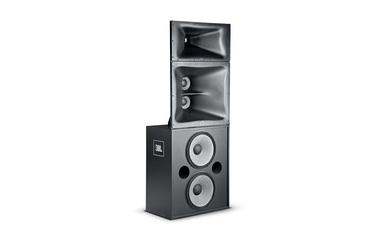
Those are 15″ woofers. So, the whole thing must be about seven feet high. And, this would sound pretty amazing in the home. You can buy a pair of these today, new, from B&H Photo, for $8000. You could have something actually very similar, in a much smaller package, which is basically the Klipsch Cornwall of the 1960s (still produced today), which is also two horns (mid and treble), with one 15″ woofer instead of two. And, anyone with a little audio aspiration could own one.
Over at JBL’s Touring department, we have this:
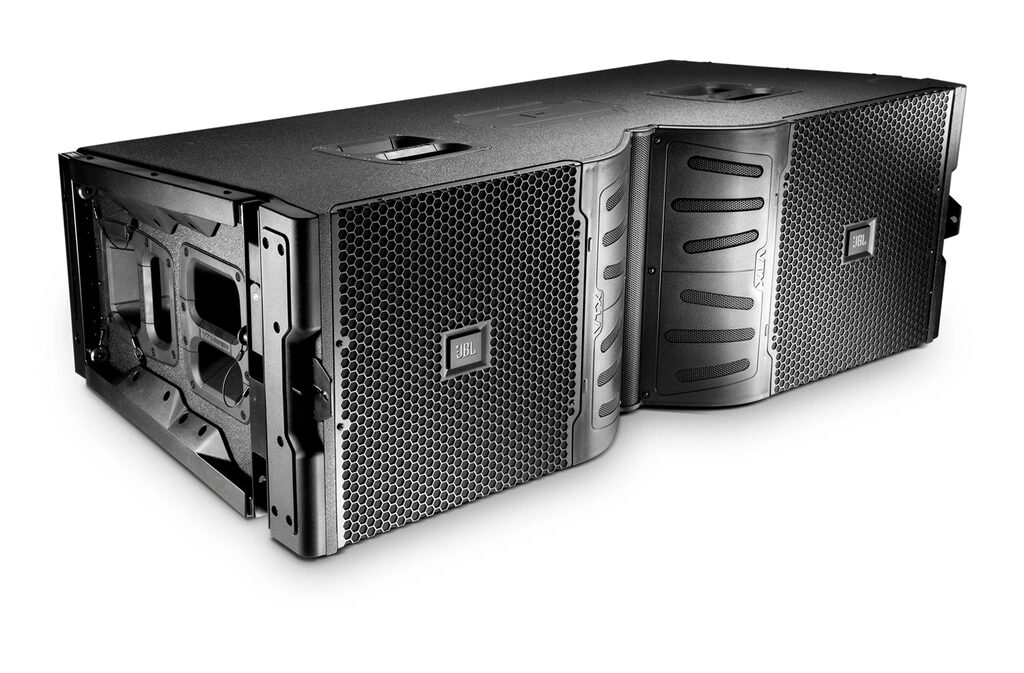
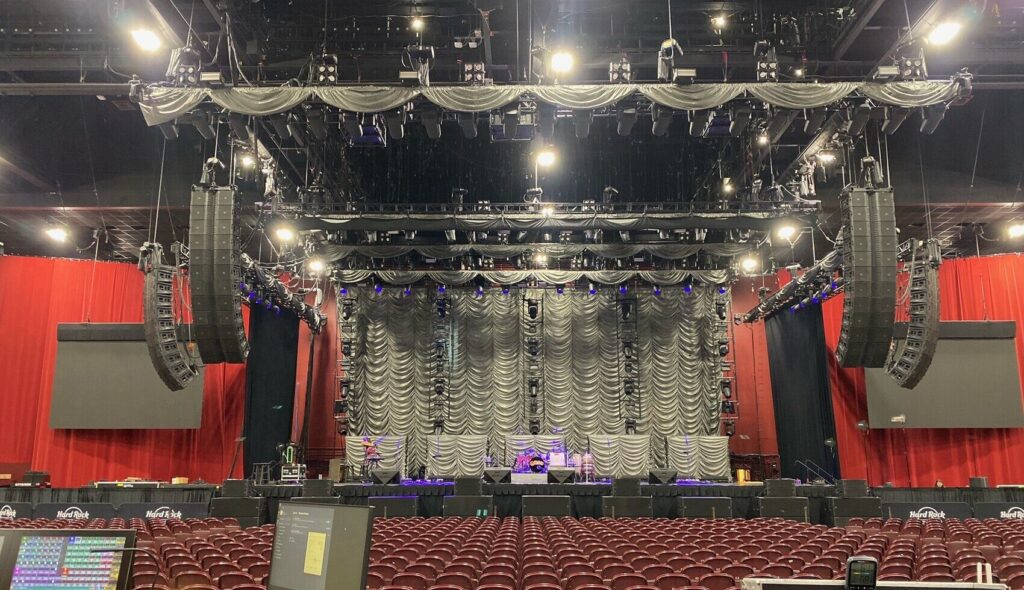
These are normally stacked in a line and suspended, the typical thing you would see at a Taylor Swift concert. It is basically a horn in the middle with two 15″ woofers on either side.
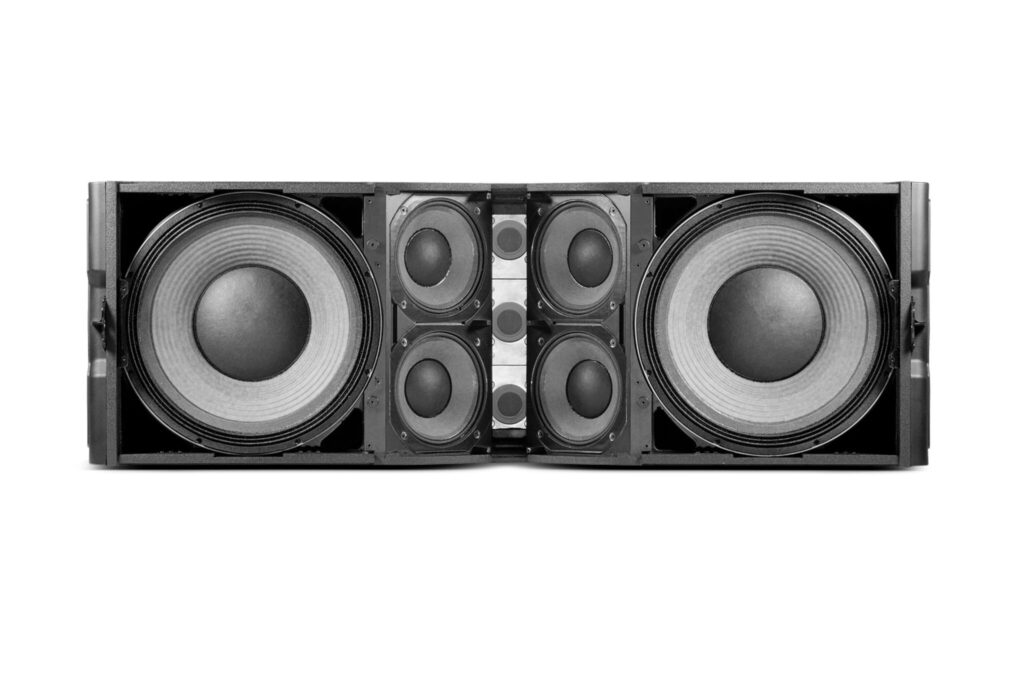
Here is what it looks like, with the horn and grills removed. There are three compression drivers loading the horn for the high frequencies, and then four 8″ midrange drivers, which then also load the horn through the little slots you can see in the first photo. Then, two 15″ woofers. Everything is multiamped, with separate amplifiers for treble/mid/bass, and digital correction and crossovers throughout.
But even the 98db Cornwall speaker — made for the 40 watt Pentode amplifiers of the 1960s — was not efficient enough for your 8 watt 300B SET. There should have been some higher-power alternatives. You could have a 300B pushpull, making 16 watts. Simplest thing in the world. Or, you could use cheap and plentiful KT88 pentodes, but instead of using them in Class AB with tons of feedback, as in the 1950s, you could run them as triodes, in Class A no feedback, and make a wonderful 25 watts of power without all the expense and hassle that comes with 1930s tubes like the 300B. Or, basically, cheaper. However, this never really happened. Even today, with all the thousands of audio gadgets available to seemingly satisfy every whim. these kinds of amplifiers are rare. (There is a guy who makes a KT88 pushpull amplifier like this … and he has a three-year backorder book. So you can’t buy one, even if you want to.)
Or, you could multiamp, putting your 8 watts of exquisite tube power on the 110db horn in the Cornwall, freeing it to fly like an eagle while your 25 watt pushpull amplifier or 200 watt transistor amplifier handled the bass. This is ambitious, but … audiophiles enjoy being ambitious. Yes, it would be complicated and expensive, but you could do it, today, for under $10,000.
The reason why I keep mentioning the Klipsch Cornwall is because it has been in continuous production since the 1960s, used copies are available in every major city, and represents a certain basic design of a large-format midrange horn, a horn tweeter, and a 15″ woofer in a ported box. This should be a basic format that is as common as the typical 6″ cone/1″ dome speaker, represented in a hundred different commercial products. But, still there is almost nothing available today that you can buy, at least for less than $10,000 and from a large-volume manufacturer. The Klipsch stuff is not necessarily so great — it is mostly a kind of reliable value proposition, a Honda Accord of good sound. You could do better. But, you might have to built it yourself.
After the Everest, JBL did the K2:
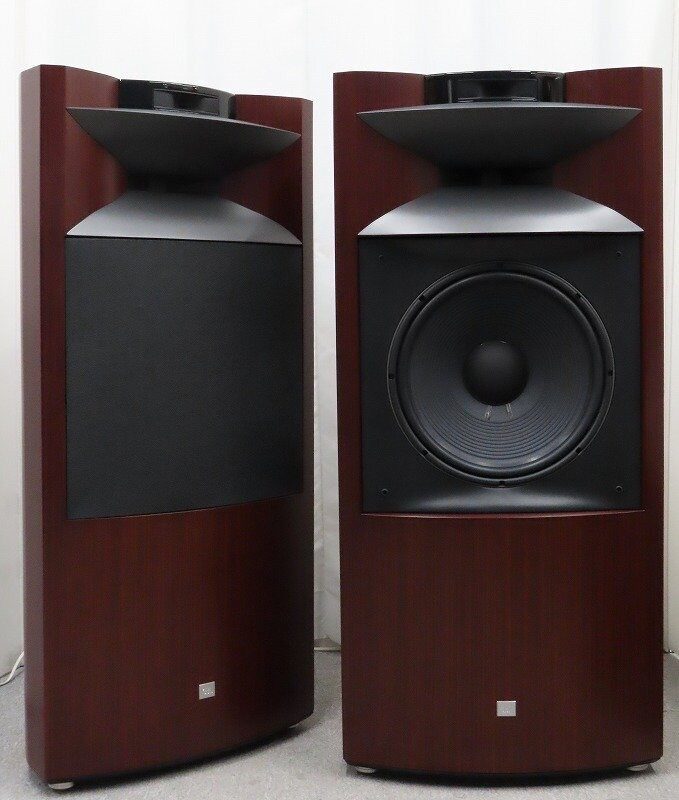
It is basically a much nicer version of the Cornwall, with a 15″ woofer, large format horn and a small tweeter horn in a box. But, a lot more expensive too.
Instead, by 2010, people went back to their cones and domes speakers. And, since they needed big power to drive these inefficient designs, they went back to transistor amplifiers. Instead of spending $10,000 to multiamp a Klipsch Cornwall into something completely astounding, they would rather spend $10,000 on speaker cables.
Nevertheless, the challenge posed by the DHT SET tube amplifiers of the 2000s shook up the transistor amplifier makers. These started to get a lot better. Also, the continuing superiority of vinyl playback, even into the 2000s, irritated the digital audio people. This also got a lot better, such that the advantages of vinyl became smaller and smaller, and now it is arguably a matter of taste — different, not better. Anyway, nobody is making new music on vinyl (or not much, or very well), so if you want to get out of the “great recordings of the 1950s and 1960s” ghetto, and you kinda like Spotify (premium), you use digital.
Those recordings of the 1960s were also done with a vacuum-tube recording chain. In the 1970s, people still used vinyl, and turntables got a lot better. But, recording studios were moving to transistor opamps (really bad sounding ones that they had in the 1970s) so that they could have a 48-track recording studio, rather than the one microphone direct to mono recordings that Rudy Van Gelder did in his parents’ living room, and are still regarded as wonderfully good sounding. The best recordings, played on an ambitious turntable, still represents a reference point of good sound that we can compare other things to.
In the 2000s, we also saw the widespread use of Class D or PWM amplifiers. No longer did you need the huge banks of heatsinks to make big power. Also, switching power supplies displaced the “linear” power supplies of the 1990s. You didn’t need that 40lb toroidal power transformer and coke-can sized power capacitors, to make big power. They were cheap. And, they sounded pretty good. Maybe not as good as linear transistors, but pretty good.
Also, around this time headphones went from a stagnant backwater, to a highly active sector, especially among young people.
2010s — present
Streaming digital replaced CDs in the 2010s. As Internet data transfer improved, the original craptastic MP3s gave way to 16/44 “redbook” CD-equivalent sound, and then, 24/96 “hi res digital” plentifully available.
Transistor amplifiers, both Class AB (conventional linear) and Class D (PWM) got notably better. Even in the midrange, ignoring for now all the issues with bass and treble, and power output, some transistor amplifiers can give the 1930s-style vacuum tubes a pretty good challenge. Maybe. It’s one of the things I want to find out — whether the DHT designs of the 1990s or 2000s still sound better than transistors.
But, the audio hobby sector got kinda … “constipated.” Much of the stuff that people ooh and ahh over today isn’t much different than what was around in 1997. It’s like 700 different kinds of grilled cheese sandwiches. It’s not even about something great — whatever your vision of greatness is — but “doing audio.” American audiophiles still have a bizarre fascination with little box speakers. Not even floorstanding box speakers, but little boxes. Like this:
Why is this?
These little box speakers are a) cheap; b) don’t mess with your decor much (they have a high “wife acceptance factor); and c) can actually sound pretty good, within their limitations. Simpler is often better in audio — there are less moving parts that have to be integrated into a coherent whole. A small box can be less resonant and problematic than a big box. So, this can be a good solution, if you have a small room, a small budget, and your ambitions don’t go beyond this tiny little sandbox.
The teeny dome tweeters have, in my view, led to the rise of a whole subculture of “soundststaging,” which I think arises from the artificial condition of producing high frequencies from a tiny point source. In real life, high frequencies do not come from a tiny point source. A musical instrument with a lot of high frequency output, like a violin or a drum cymbal, is quite large. It is not a tiny point source. In an ensemble, like an orchestra, the source is even larger. In live amplified music, high frequencies come from bullet horn tweeters and 1″ compression drivers, which do not produce this “soundstaging” effect, at least not in the same way. This makes many people uncomfortable.
But, I think the main reason for the ubiquity of these little shoebox speakers is that they are easy to review.
For the typical equipment review — an amplifier or digital source — you get a box that is not too expensive to ship via UPS. You listen to it for three weeks, and then you send it back. This is good for making content that you can then put on Youtube or elsewhere.
Let’s say that you were an audio reviewer who got into the tubes and horns thing around 2005, and had a really great tubes and horns system. Then what? Are you going to spend the next 20 years telling everyone that you really like tubes and horns, and that the gear-of-the-day still isn’t tempting you from your personal audio nirvana? That is what you could do, and hopefully should do, as a private audiophile. But, if you have to make content, then you would also have to move all the dozens of new products through your home, including all the dozens of new transistor amplifiers to drive your shoebox speakers.
Just imagine how hard it is to ship around a middling size speaker like the Klipsch Cornwall, and then pack it up and sent it back three weeks later. Ugh. Now how about a Tannoy Autograph? You would need custom crating, pallet shipping, and four workmen just to move the thing. It’s like moving a piano. And it’s still only one channel.
So we have the typical audiophool who: a) probably got started with midfi shoebox speakers; and b) sees nothing but “expert” reviewers reviewing nothing but shoebox speakers one after another.
Along with this comes the idea that the audiophool is supposed to move gear in and out of his house constantly, like a reviewer. Which also costs money. When, maybe you should find some speakers you like, and live with them for ten years or so, in which case their size and expense is much less important.
The stupid thing is that, of course, audiophiles get a little ambitious, and soon we want to “optimize” these shoebox speakers, so we get the $20,000 shoebox speaker, or similar floorstanding speaker. What was supposed to be a cheap and convenient solution, that sounds pretty good within its inherent limitations, has now become the opposite.
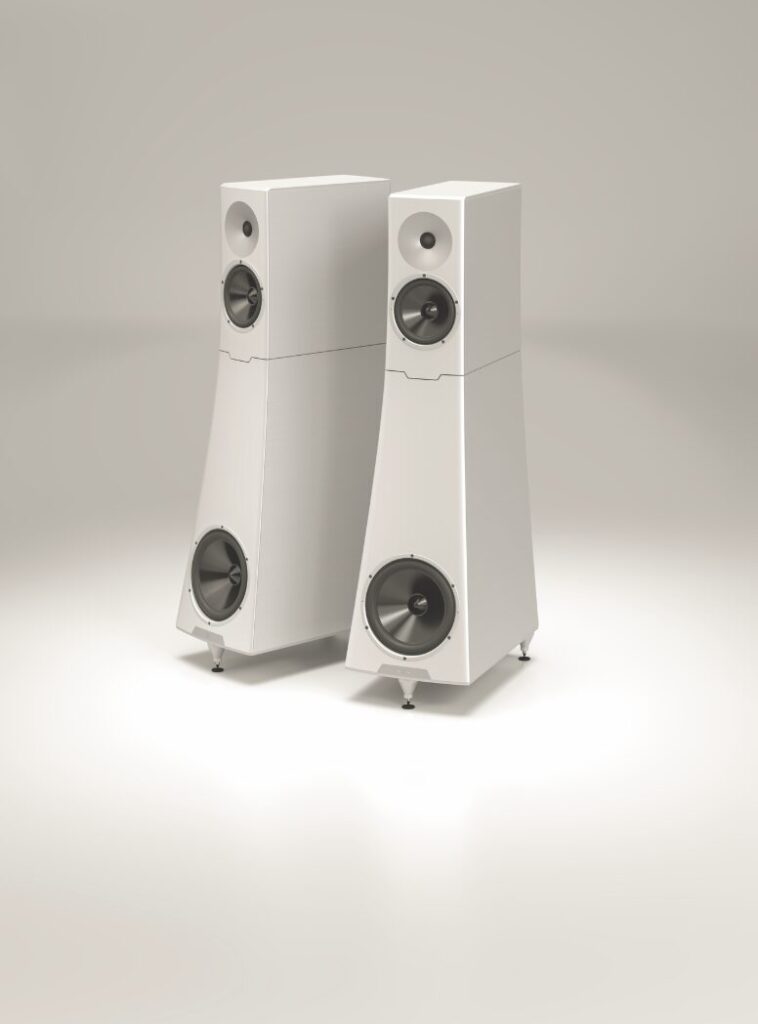
Here is the YG Acoustics Hailey 3 loudspeaker, which we can see is a little shoebox speaker sitting on a base with a woofer for additional bass, and it only costs $68,000. And so we have legions of audiophools with their $3000 shoebox speakers, hoping and dreaming that, if they win the lottery, they can someday afford some Hailey 3 loudspeakers. Or anyway, they can fantasize about it, as they are encouraged to do by The Absolute Sound, who definitely knows what they are talking about don’t you think?
Or, here is a guy who has been an audio reviewer for years, and has had hundreds of products costing millions in total through his customized listening room. And after all this, his “retirement system” is:
Is that really the best you can do, even at a price point, after doing this as your full-time job for decades?
Meanwhile, Klipsch left the value sandbox for a moment, and built something grand, the Klipsch Jubilee, which is my idea of one way you can kick ass in the present era.
I might point out that the Jubilees are multiamped, use digital processing, and the big front horn is a conical horn. Personally, I think I would prefer one of today’s coaxial compression drivers to the single big driver that Klipsch uses over a very wide range. It is a 7″ diaphragm compression driver with a 5″ voicecoil … which is something that you don’t see everyday, or ever. But if they can get it to work, there can be a lot of advantages from using just one driver.
This video from YouTube gives a hint of why we like these big horns instead of the little boxes, and why we drive these big horns with vacuum tube amplifiers, in this case direct-coupled amplifiers (no passive crossovers) — even these 1960s-style items from McIntosh, which are nowhere near the cutting edge in tube amplifiers. Yes, it is a YouTube video, probably recorded on an iPhone, but listen to it with headphones and you will get what I am talking about.
In the Really Big category, we have this, from 2025:
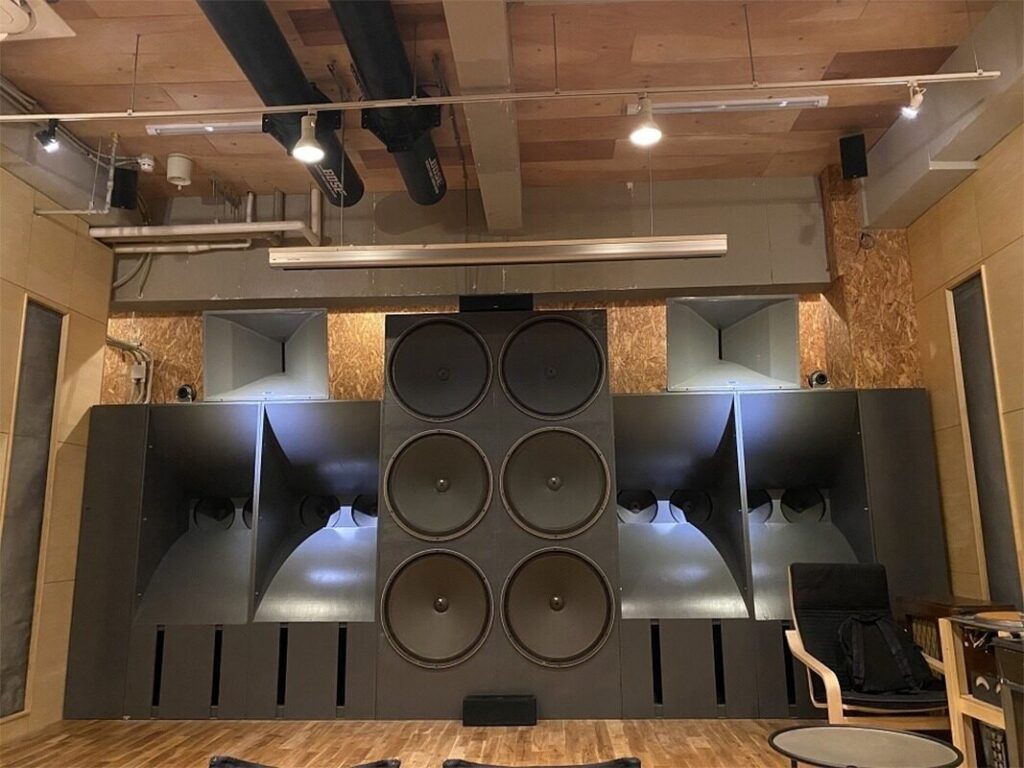
I don’t really recommend this sort of thing, but it is cool that someone did it, and he probably had more fun along the way than the guy who spent $5000 on a power cord. Altec 210 bass horns from the A2 system; Altec Manta Ray horns (conical, with a diffusion slot throat, basically the conical version of the JBL 2360) and some really big cones for lower bass duty. These similar Fostex woofers (not the same) are expensive, but the rest of it is basically a circa-1990 junkpile system. If you replaced the big woofers with more standard-production 18″ woofers — which are certainly adequate, when you have six of them — you could have probably got the whole thing done for $10,000, even including eight 515E woofers. (More today, due to inflation and the increasing scarcity of old Altec theater gear.)
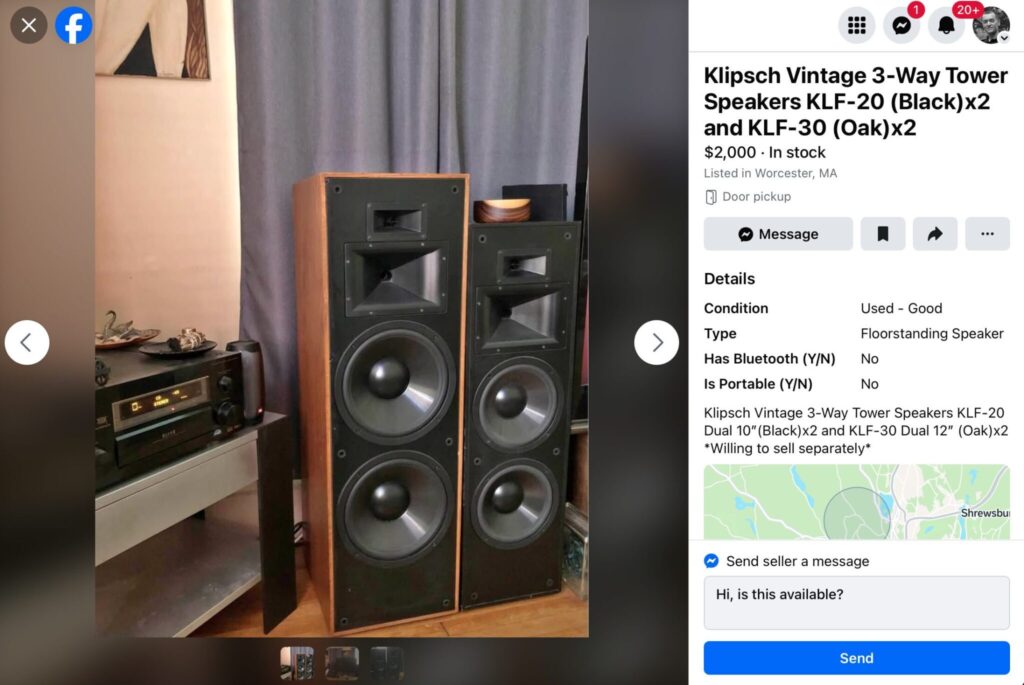
Thirty seconds of searching comes up with this:
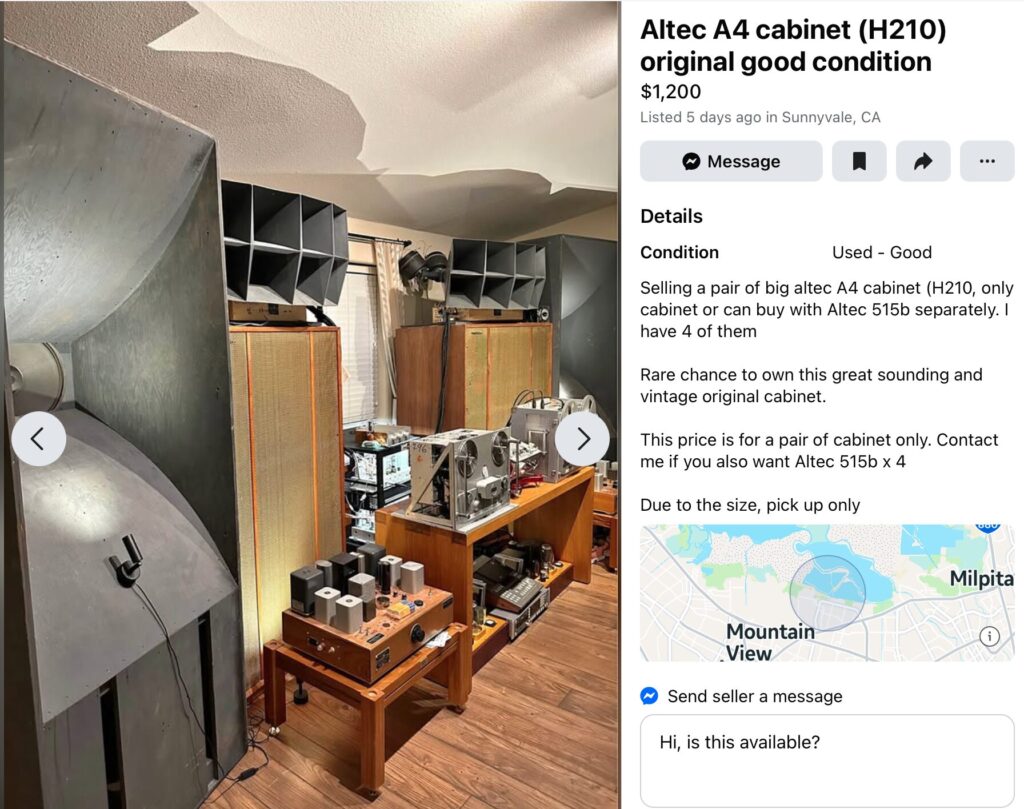
Today’s budding audiophile could find themselves some Klipsch KLF30s used, in their neighborhood, for about $1200, and have fun playing with that. I wouldn’t say this is “the best!!!,” but it is pretty good for $1200, and will give you an idea of what is possible when you escape the shoebox speaker plantation. After you fool with it for a few years, you can probably sell it for more than you bought it for.
It might sound like crap, but that is probably because your amplifier sounds like crap, but you didn’t notice before. Speakers like these reveal things.
After all these decades of refinement and improvement, the basic cones-and-domes-in-a-box speaker can deliver a lot of satisfaction, for those who wish to operate in that modality. It is a kind of miniature and limited milieu, in my view — like hotrodding a Honda Civic. But this is all just about having fun anyway, so why not? Maybe that is the best solution, for you. But, it is not the only solution.
Today, digital reproduction is really quite good, and I think that transistor amplifiers (including Class D) are also much more competitive with vacuum tubes, than they used to be — although that is something I want to explore for myself. There is a ton of really good gear out there, and most of it doesn’t cost that much money. What you can get for under $1000, in electronics, can be really impressive.