
I’ve been a lot more active with my audio hobby recently. With a little more room to work with, I’ve been able to build out a number of things that I’ve had on my mind for a long time. Still, the process has been very, very slow — mostly because of all the other things to do around here, and also, because mostly just plain headphones are actually good enough.
I did eventually finish the LM1875-based amplifier that I began in late 2024. This was an incredible struggle, completely ridiculous actually considering the basic simplicity of this project. Let’s just say that I am happy it is up and running, and I don’t have to rebuild it for the … eighth or ninth, I can’t remember time. Now that I have a nice SLA battery power supply and custom charger (which I also had to take apart about ten times before escaping DIY audio hell), I will probably build out similar amplifiers using the LM3875 and LM3886 chips I have around here, which shouldn’t be very difficult and satisfies my curiosity there. The LM1875 amplifiers have been driving my Yorkville U215 speakers, using the passive crossovers, rather well actually. This plug-and-play solution sounds pretty good. But, of course, we can’t just stop there — that would be like driving a bone stock Gen4 Supra. Multiamping this speaker is one of my goals for 2026. Because, that’s what we do around here. Also, I am interested in using digital FIR filters to fix impulse response, an unavoidable problem with passive crossovers. This should take place over the summer and autumn, and will probably involve a lot of optimization possibly including the use of Dirac Live (some software). Whenever I have direct-coupled amplifiers and compression drivers in the past, I have liked the results.
If you are going to play with the LM1875, I found it best to use PCBs that you can find on eBay for about $10 — including parts, but the chip they give you is a fake. (Imagine a fake LM1875, when the real one costs $1.58.) Given my previous experience with HF oscillation or other nastiness with these chips (including irritating DC offset on the outputs), I opted to use all the stabilizers and protections, including the 0.1uF bypass caps on the power caps, the output Zoebel filter, the 22uF DC blocking cap in the feedback loop, and the little 200pF cap on the input. None of these should have much effect on the sound, except the 22uF DC blocker, where parts quality might make a big difference. No input cap. Lower parts count is not necessarily better. I hand-soldered a little 1206 SMD resistor across the leads for the feedback resistor. (Use tweezers.) I also soldered an even smaller 0805 SMD capacitor across the inputs for the RF input capacitor, which I don’t think I would recommend. Just use the little cap provided with the PCB. My power caps were 100uF Elna Cerafines, a quality item that I have around here, and the main resistors were also nice items, from Caddock and Riken. There are also some 1000uF Elna Cerafine caps, across the shared battery power supply. The 22uF DC blocker caps were audio-quality nonpolars from Nichicon or Panasonic, and you could use fancy Audio Note stuff here too if you like that sort of thing. Or, maybe try it without first, and add them only if you need them.
As part of this (mostly it is just an excuse to make things), I have been building out some vacuum tube solutions for this multiamp project. This winter, I’ve been working on a push-pull amplifier using the 6DN7 tube, a little octal item probably from the 1950s, that is basically half of a 6SN7 and half of a 6BL7. With just one 6BL7-type triode in the envelope, we can run it at its max rated capacity of 10 watts plate dissipation, 250V and 40mA — about equivalent to the 45 DHT. These were popular a few years ago among DIYers, but not so much today, and I paid about $9 each. These octal triodes from the 1930s-1950s, especially the famous 6SN7, are some of the best tubes of the entire vacuum tube era. In Class A pushpull, it makes about 3 watts. The 6SN7 half is basic RC-coupled, balanced/differential, using the usual Soviet K40Y PIOs that I have around here. Nothing fancy, but good — and combining some Kruschchev-era caps with Eisenhower-era tubes is fun. Inputs are single-ended, and use some 600 ohm line transformers from Sowter that I’ve had around here forever for splitting duties. (The outputs of my DAC/digital crossover should drive 600 ohm inputs easily.) Along the way, I discovered that the Sowter 8751 transformers that I bought some time back for I think it was $20 a pair (used) are actually a new-production copy of the 1960s-era Neve L01166, which now sells for about $500 each used … why I don’t know. It seems to have a reputation as a microphone input. Output transformers are again the little 10 watt Hammond 1609, 10K plate-to-plate. In time this will drive the compression drivers on the U215 speakers.
I replaced my 25-year-old Sennheiser HD600 headphones with very similar cans from Drop.com (formerly Massdrop.com), here. These are still made by Sennheiser, and you can get them for $179, which is less than I paid 25 years ago. They are still considered some of the best headphones ever made, at least in the sub-$1000 class — mostly for the liquid and organic midrange, which is what longtime audiophiles care about, not treble and bass. It is actually nice to have somewhat rolled-off treble and bass, so that they don’t interfere with the midrange. My old cans somehow got their drivers dented along the way. If you can’t tell the midrange difference with these headphones and others, it’s probably because your electronics don’t have a “liquid and organic midrange.”
Also, my Fiio X11 portable music player upped and died, due to a swelling battery that also took out the electronics and broke the case. Ugh. I decided to try the Fiio KA17, a little USB dongle that you can plug into your notebook computer. This uses the USB power supply, so no more swelling batteries. At $170, you get a lot of good sound here for a bargain price. It is basically the audio output section of the much more expensive X11, without the battery and without the touchscreen, onboard memory and Android operating system. Just the good stuff. Yes, you can plug it into an iPad, at least a newer one with a USB-C plug. This provides a little portability — enough for a bus or airplane, but you wouldn’t want to walk around with it. The power draw is too much for an iPhone. You can still use it with an external battery power supply, but then you have quite a cable octopus. Anyway, I declare that It Sounds Good. Not as good as some other things I have around here, but good enough that I can just enjoy the music without being bothered by it. If I wanted something with a battery that plugged into an iPhone and you could walk around with it in your pocket (a large pocket), I would go with the Chord Mojo 2, now a somewhat dated but still very good product.
The prolific Fiio guys have released a more ambitious USB dongle DAC, the QX13, which is probably a little better. Using Sennheiser HD600s with a USB dongle is a little silly — the best match, if you are emphasizing portability, is with IEMs such as the Etymotic ERX, again at Drop.com for a very good price, $170. At 300 ohms impedance, the Sennheisers need a lot of voltage swing. Yes, you can use them on the KA17 (I tested it), but you might be at the top of the volume range, and for certain recordings (probably classical) it still might not be enough. There is also a “balanced” jack, which I use with a balanced cable and my Audeze LCD-2 planar magnetic headphones, and it also works well. (The big planar magnetics are a nice option when I want more “body” in the sound. Their diaphragms are probably 100x larger than the little domes in the Sennheisers. That doesn’t make them “better,” but it does make them “bigger.”)
The Etymotic ERX IEMs (“in ear monitors,” basically earbuds) use a single balanced-armature driver. There are a lot of advantages to using a single driver, avoiding the complexity and integration issues of multi-driver solutions. I would definitely try the single-driver ERX, and see if you like it. More drivers doesn’t make another product “better.” Just more complicated and expensive.
In other words, for $170 (KA17) + $170 (HD6XX or ERX) = $340, you can enjoy listening to music using Qobuz or Tidal (I also use Audirvana), and call yourself an “audiophile.” Quite good sound is available today for not much money.
If you are a little more ambitious, and since I am a Fiio fanboy, I would try the new FT7 planar magnetic full size headphones. At $750, apparently these compete nicely with the most ambitious “reference class” $1000+ headphones in the world. Using this with a $170 USB dongle is a little silly, but it would work and sound good. Later on, you can spend your next $750 on something more ambitious to drive them.
Since I was complaining about the state of American Audiophilia recently, I thought I would point out Something Completely Different, as described by Herb Reichert in Stereophile.
But first, I have to describe Herb Reichert — perhaps the one single person who, in the past 40 years, has most embodied the spirit of audiophile adventure in the United States. When I talk about “audio gnomes” who helped save 1930s-era Western Electric theater horns from the landfill in the 1980s, and shipped them to Asia, I am literally referring to Herb Reichert. When I am talking about the effect that the Audio Note Ongaku had on US audiophiles in the early 1990s, I am talking about Herb Reichert, who was Audio Note’s distributor in the US. When I talk about American DIY builders using exotic Japanese artisan-grade new-production tube output transformers from Tango and Tamura in the 1990s, I am talking about Herb Reichert, who was Tango’s US importer. When I talk about the realization that people had, around 1999, that dirt cheap monolithic power opamps like the LM3875 could sound better than big name gear of the time, Herb Reichert was there too. Besides this, he was a fine art painter.
But this report is about a room in Manhattan, where, in 2026, a Millennial in his thirties plays 78 shellacs on a vintage RCA system.
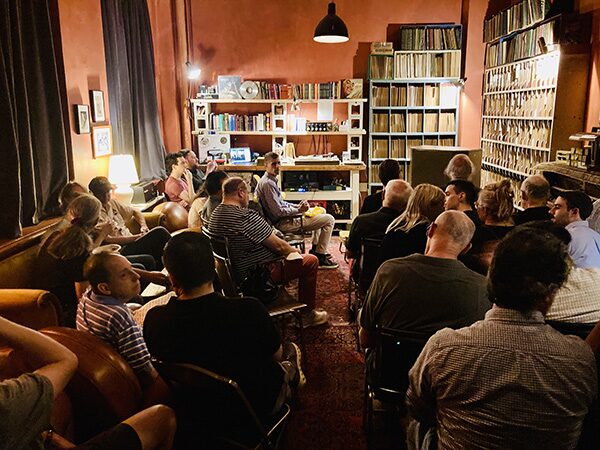
The speaker is an RCA LC-1, a 15″ coaxial speaker from the late 1940s — a driver (and accompanying speaker) that is so rare, that hardly anyone knows what it is. In the future, I can see prices on these going north of $10,000, like the WE 755A and WE 555. But for now, you might find one for a modest price.
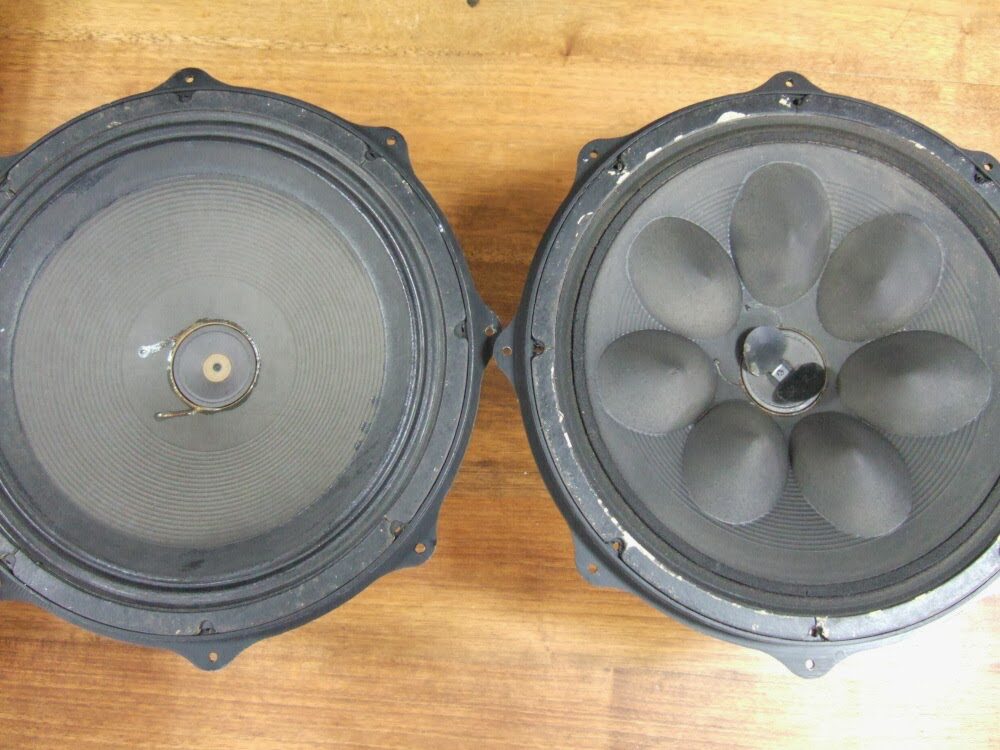
Here’s what they look like. They have some bizarre cones attached to the driver, and a little teeny thing in the middle for treble. I think the one on the left is the original “LC-1” version, and the weird one on the right is the “LC-1A” version.
After experiencing this system six times, Stereophile Contributing Editor Ken Micallef told me by text, “I’ve never heard music sound that alive. The energy was like the big bang, right there in the room. That Ghanian record, the way it captured the weirdness of their harmonies. It had a very special energy I’ve never heard before.” It also captured the touchstones of the various solos. Those musicians had entirely different references than contemporary musicians. They were weird or odd or more connected to the Earth in some way. … The Hot Club’s system showed all that. It was kind of spooky.” When Ken asked me what I thought, my answer came easy. “I feel the same as you: Matthew’s system has a raw, high-energy presence and an unfiltered clarity that allows instruments and performers to sound spooky real.” It’s my kind of sound.
This is a very different kind of thing than talking about “soundstaging” or “accuracy” or “neutrality” or “removing a veil.” As Susumu Sakuma said poetically, a great system allows you to understand the musician’s philosophy of life. It preserves, or maybe enhances, or maybe even simulates, the tone, subtlety, and timing that serves as the transmission mechanism between the musician’s brain and yours. (Yes, I did take the train out to Chiba and spent an afternoon with Sakuma at the Concorde restaurant. I think it was 1999.)
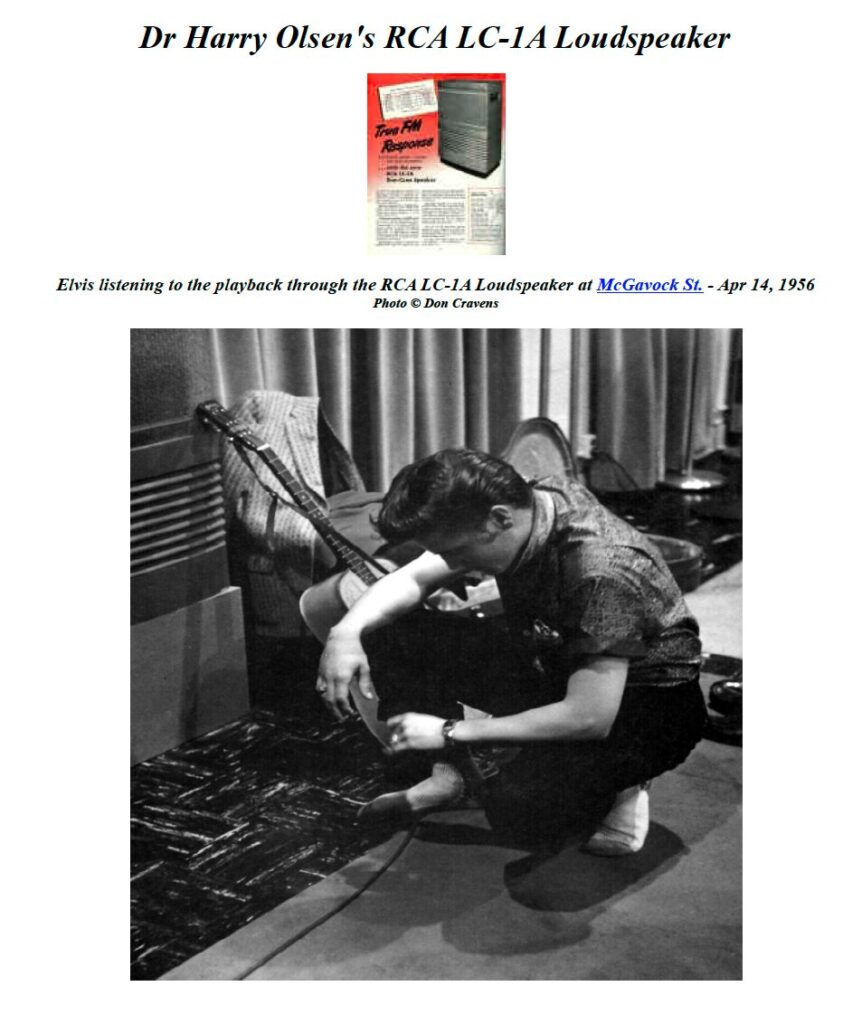
The system also uses an amplifier designed by the same guy who did the LC-1, RCA’s chief design wizard, Harry Olsen.
I heard some LC-1s at one of Jonathan Weiss’ “Tube Tasting” sessions, powered by a GM70 SE amplifier built by Jim Dowdy. They were in simple boxes, but since then, Weiss built out a set of backload horn cabinets for the LC-1, designed by Harry Olsen but which never went into commercial production. Olsen’s original pencil drawing of the cabinet ended up with horn designer Bill Woods, and this is what happened:
The late 1940s were the very end of the 78 rpm era, and the beginning of LPs. So, an ambitious design from that time period might be expected to sound good with 78s, especially when you play the 78s on a modern turntable far better than anything from the 1940s. There are reasons why nobody makes 15″ fullrange drivers anymore (or, it is a very small club). Basically, it is the kind of thing that is not hard to make sound bad, if you want to. Its sweet spot is very narrow, in terms of music types, and listening conditions. But when it works well, it can be very, very good.
You can tell that everyone involved had a good time with it. Can you see why I get a little bored with yet another 87db 6″ cone/1″ dome bookshelf speaker?
There are a few people making things like this today. Here is a new production 15″ fullrange driver, on an open baffle. Weird, but good. I myself had a speaker like this once, with a 15″ woofer from Supravox used fullrange up to about 6khz, with a bullet tweeter to fill in the top end, on an open baffle. In mono. I think the whole thing cost me about $400. Fun.