
This is from Mike Shedlock:
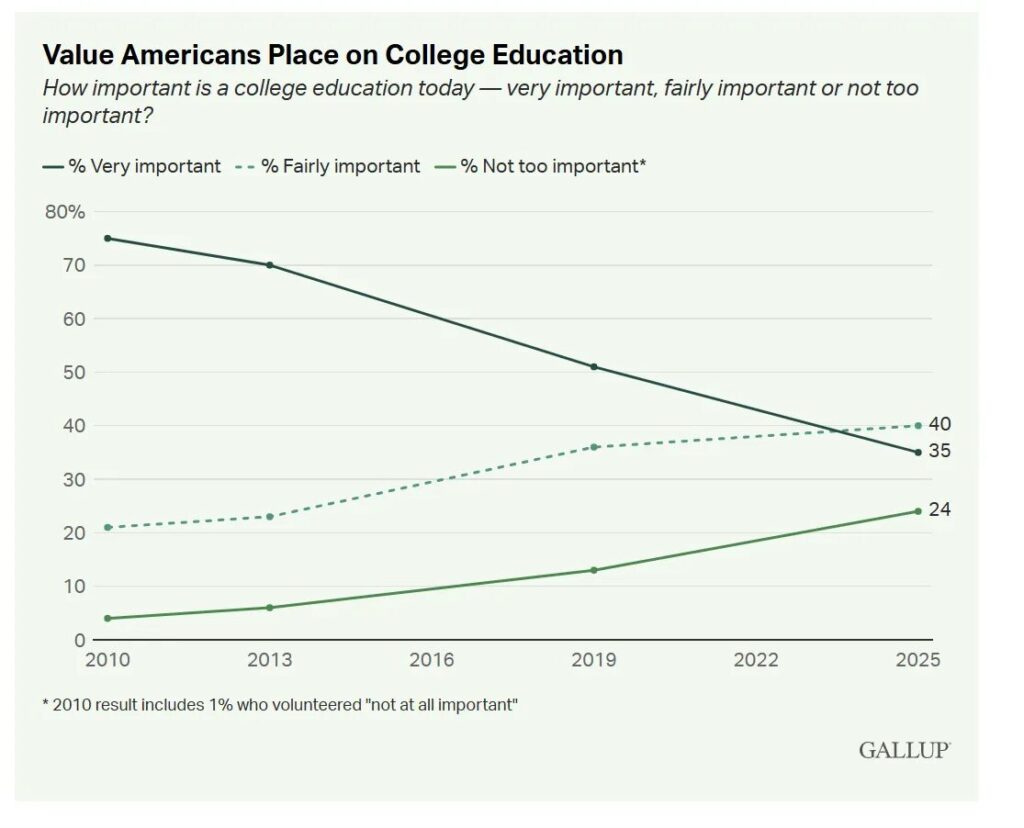
This is an amazing decline in trust in a major institution just since 2010. It is why I put together the Build Your Own College series in 2020.
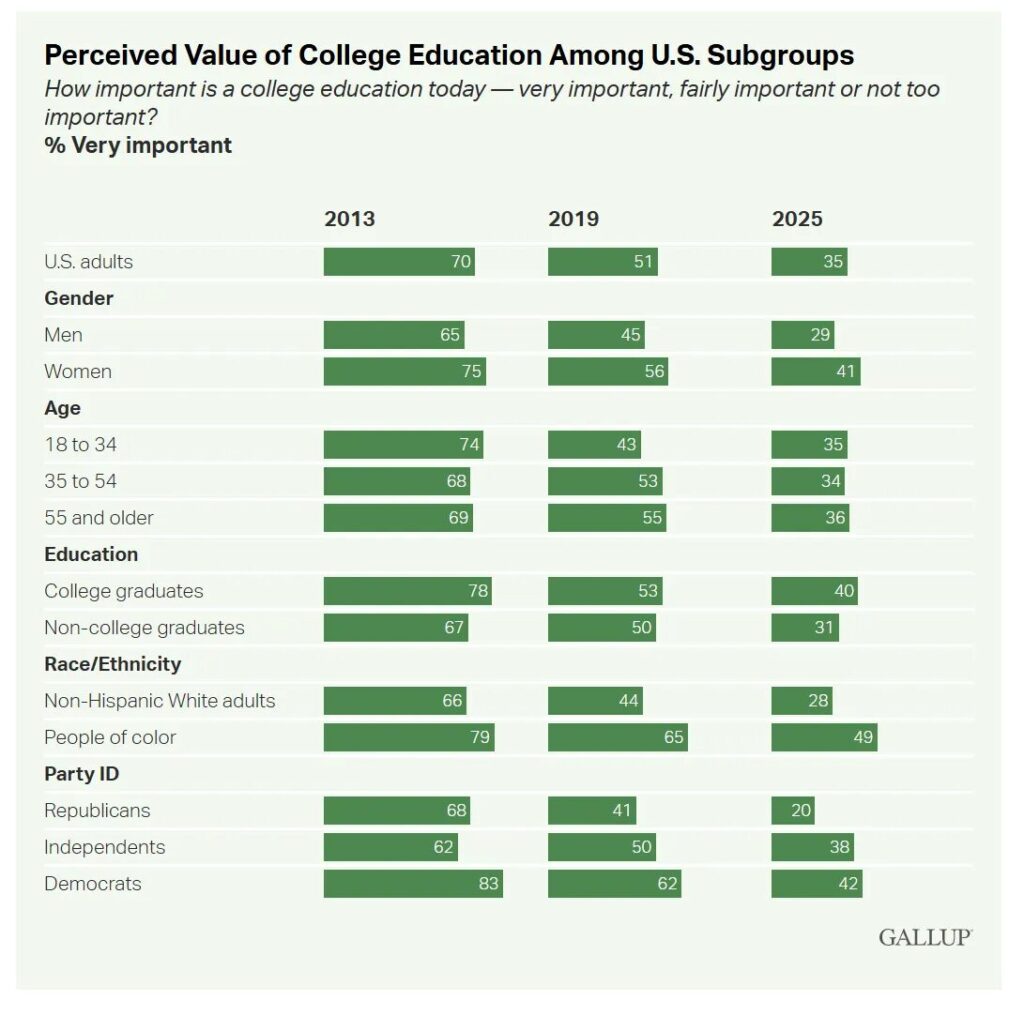
Among all adults, we find that the percent that view college as “very important” has fallen from 70% to 35%. However, the support among men is even less, at 29%. There doesn’t seem to be much difference based on age. Support among college graduates is higher, but not that much higher, at only 40%. Only 40% of those that have actually gone to college think it is “very important.” Whites have a surprisingly low support rate, only 28%. And Republicans are even lower, at 20%. This is no surprise since colleges have been openly hostile to Whites and Conservatives for decades.
Of course, this raises the question: How about White Conservative Men? I would guess it must be around 15%.
Educating White Conservative Men is, of course, the original purpose of college education. The top schools, including the Ivy League, were Men-only until about 1970.
My view of college today is:
Women mostly shouldn’t be attending college at all. They should live at home with their fathers until they are married — around Age 18-22. The main advantage for women attending college is finding husbands, of a certain level of intelligence, education and social class. Basically, men like themselves. Likewise, men should also aim to find a wife at college, also of a certain level of intelligence, education and social class. Women can still be educated, while they are living at home with their fathers. Even just reading a couple hours a day, in a somewhat casual fashion, would be a far better education than is available at nearly any college today. Here is a good booklist.
About half of Men attending colleges today should not be there. The Lower 50% of college education today is remedial high school at best. Now Harvard is offering Remedial Math classes for on-campus undergraduates. If you got a crappy high school education, you can remedy that with some reading, and maybe a little math if you think that is necessary. (Try Saxon Math.) Men of moderate intelligence actually don’t like and don’t enjoy highbrow intellectual pursuits. They don’t want to read Paradise Lost or Locke’s Second Treatise on Government. They don’t enjoy it if they do, and get nothing from it. They want to watch sports, or play video games.
One of the great errors of education, over the past century, is the idea that subjecting people of moderate intelligence to the activities normally preferred by those of high intelligence, will make those of moderate intelligence more intelligent. It does not. It only irritates them — irritates them so much, that very soon they are applying pressure to the institution to dumb down the curriculum, so that, even if they still don’t enjoy it, they can get it done more quickly and move on to something they like, such as drinking beer. These men, of moderate intelligence, should be more vocationally-focused.
Take a rollicking fun story, but written in a sophisticated 19th century style, such as Moby Dick or Rob Roy. Just read it. Did you like it? If you liked it, then maybe you are suited for college-type studies. If not, then move on to something else. Most people didn’t read this stuff in the 19th century either. Did the men who worked on whaling ships in the 1850s read Moby Dick? I don’t think so. It was for the elite class — not only the socioeconomically elite, but also, those men of modest means who, in their free time, read serious books.

While there is a lot of whining about women outnumbering men at colleges, in fact attendance of college by men has also risen by about 50%, from about 23% to about 35%. That seems way too high. The 23% of the 1980s and 1990s seems like enough — maybe, more than enough. The 15% of the 1960s is probably enough. In other words, about half of today’s level.
Many of the Men who justifiably should be going to college, should be focused basically on vocational interests. This is mostly “STEM,” which is basically vocational training beyond the introductory level. Probably, you can find a way to do this that doesn’t involve an actual college. It is easy to find an online resource to teach just about anything, especially in technical fields. Try The Great Courses, or MIT’s online resource. This can be combined with some kind of testing and certification, usually available for technical studies at the undergrad level. The CLEP exams cover a wide range of subjects at the undergraduate level. The Python Institute offers a wide range of testing and certification for computer programming. Probably you can find something similar for just about any technical field, at the undergraduate level. If you are interested in getting a technical education at the undergraduate level, using one of these resources, I would find a “mentor” who has basically done what you intend to do. For example, if you are interested in a pre-med course, then I would find someone probably in medical school today or recently graduated (in other words, who has a recent memory of pre-med study themselves), who can basically guide your progress. If you are interested in an engineering course, I would find someone who has recent experience in getting an engineering degree. I think you could just find a college professor that you like, and pay them a little bit for advice (without actually attending the college). I can imagine there are a lot of college professors that would happily guide your online course selection and completion, for maybe $3000 a year.
For many centuries, vocational training for most Men would begin around Age 14 or 15, as an Apprenticeship in some trade. Even into the 1930s, most American Men did not study much beyond eighth grade. This came to an end in the late 1930s, as a result of a ban on child labor. This ban led to widespread high school attendance after 1940. For young men, who have a sense that they are best off learning a trade or a skill, or even some form of entrepreneurship, I would begin around Age 14-15, probably in a part-time sort of fashion. This can then lead either to more formal training, as at a Trade School, or perhaps on-the-job training after Age 18.
Of course you can just go to a college. But, I would have a hard focus on technical studies, and ignore “liberal arts” or “general education” at these institutions. They are corrupt and useless. This STEM/vocational focused college used to be known as a “Polytechnic University.” We can broaden these “polytechnic” studies beyond STEM to include vocational training in such things as accounting and business, or property management. Plus, medical fields such as nursing, now known as STEMM (“Science, Technology, Engineering, Math and Medical”). You can study “liberal arts” and “general education” on your own — and you should. Just read some books. Again, you should probably have a mentor or guide as to what is a worthwhile use of your limited time and effort, in this regard. In the past, you could go to a State University, for technical or STEM subjects, and for in-State students, the cost was very reasonable, and the education was good enough. Today, the costs are a lot higher, and the education is questionable at best, which leads us to look for adequate alternatives.
Some men are actually exceptional, but not exceptional in a way that is compatible with college. They may be great leaders of men; or great businessmen and entrepreneurs; or great salesmen and persuaders. They might have a brilliant future, owning a chain of gasoline stations and convenience stores. Many of these would be well off undertaking college-type study. It will add that special and important part that won’t be gained from a lifetime of business. But, many might just not benefit from it. They might be best off getting started in their chosen field of interest.
This leaves that small fraction of Men, of sufficiently high intelligence and with diligent study habits, and sufficient financial backing, who pursue what has long been considered the highest and best form of education, the Liberal Arts education. “Liberal Arts” mostly just means “non-vocational.” What subjects are of such importance, that we should set aside some time to study them in detail, even though they do not have much direct vocational value? I would put this around 10% of Men, maybe less.
While we tend to have the idea of “Liberal Arts or Vocational,” in practice it is really “Liberal Arts plus Vocational.” Mostly, these Men get their vocational training later, in business or law or government — probably on the job, possibly at a graduate school of Business or Law or International Relations. But, it is pretty hard to get a good Liberal Arts education, while you are working and maybe starting a family. You just don’t have time and energy to read a lot of good books. That’s why, literally for thousands of years going back to Ancient Greeks and Romans, the better sons of the better families would set aside roughly four years for this purpose.
Even those few young men, perhaps of wealthy families, who don’t necessarily have to make a living in the common fashion, they too need training in what you could call their “vocations.” Being rich isn’t easy. How do you train a young person to be able to pick a good private equity fund? Or not to get scammed by some “wealth manager”? Or pick a manager for the family business? Or, perhaps, to buy art that doesn’t suck? Or, donate to a philanthropic cause that is actually worthwhile, and to a philanthropic organization that achieves a lot with only a little bit of money? Or pick a good politician to back in the primaries?
One problem with this, which has also been around since the days of the Ancient Greeks and Romans, is that young men who have not done much of anything vocational up to Age 22, tend to have a rather poor grasp of typical daily life. There is a difficult transition to some vocation or occupation. They can feel like they have fallen behind their more vocationally-oriented peers, either of the Trade variety or also the STEM technical fields.
There is probably no good way of avoiding this. It is one of the costs of a Liberal Arts Education. But, at least a young man can be aware of this, and not try to make the Liberal Arts themselves into a vocation.
This kind of Liberal Arts education has also been called Leadership Education. It is the education for Leaders. Leaders, of a society, need substantial knowledge of government, history, economics, business, foreign relations, basic familiarity with science and technical fields, religion, literature, philosophy, and familiarity with all kinds of cultural attainments including architecture, music, visual arts, drama (or movies), and all kinds of aesthetic crafts including fashion, cuisine, gardening or interior decoration. The great accomplishments of the nineteenth century, in all of these fields, were because there was a small but significant number of men who were educated in all of these fields. They had great music and architecture because they had a lot of people who were familiar with great music and architecture, even though they may not be musicians and architects themselves. These Leaders can rise to become President of the United States, such as Thomas Jefferson, or maybe they will just be leaders in their community — even just regular people with a job, but who influence their families, and those around them, informally through their knowledge of business, government, law, economics, history, literature and the arts. When they build a house, they build something beautiful, because they have some knowledge and experience in what a beautiful house is; and this becomes an example in their community.
For example, they could build a house like this:
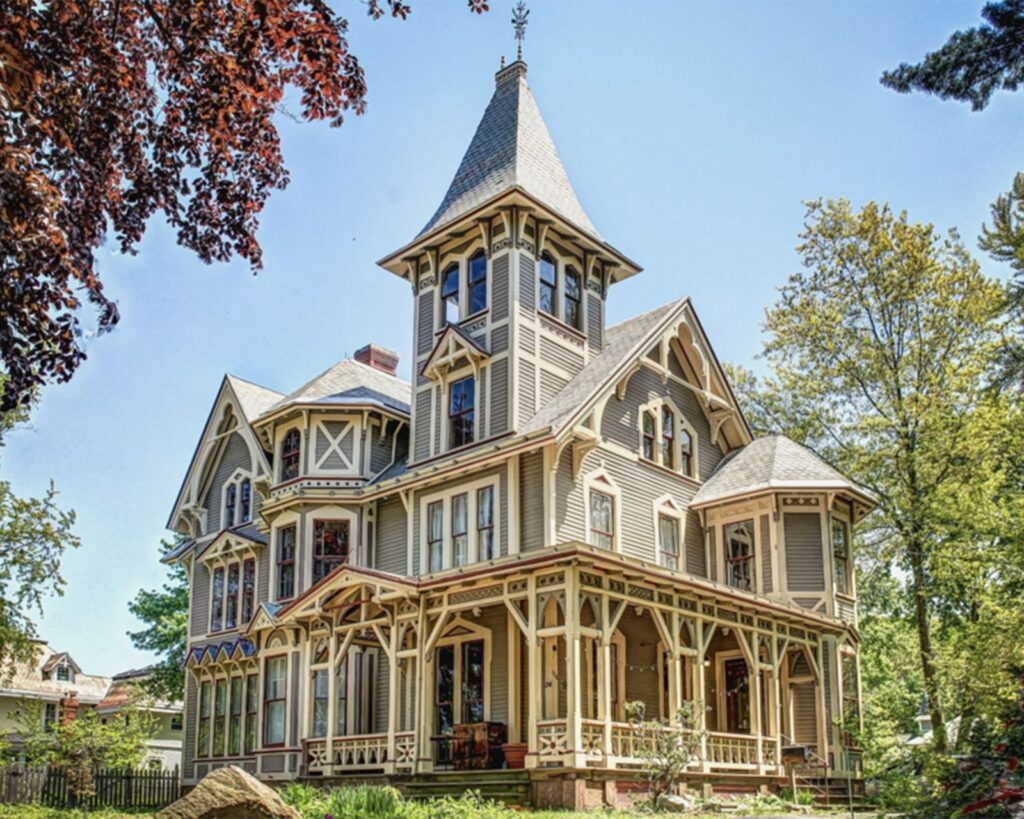
Instead of this:

And if their budget does not permit such extravagance, they can build a house like this:

Plus, Leaders need knowledge and familiarity with all the various challenges and issues that a society faces in its time. Today, for example, we have problems with housing availability and healthcare. A good Leader should be familiar with the problems, and be able to create good and workable solutions.
Along with all this, a student should develop certain high-level intellectual skills. These were known as: Grammar, Logic, and Rhetoric. Basically this means: “Can you understand what the author is saying?”; “Can you analyze and form a good response to the author’s arguments?”; and “Can you express your own views effectively?” In practice, this is a lot of reading, discussion, writing papers, presentations, and so forth, for a long time the bread and butter of a “Liberal Arts Education.”
Once you see what we are trying to achieve, four years seems like hardly enough time to do it. And, you can see the value of spending four years to achieve at least some progress toward these goals.
Once you see what we are trying to achieve, you can also see that hardly any institution today is going to help you achieve it. It is just a waste of time — maybe worse than a waste of time, since you can pick up a lot of horrible Leftist Indoctrination along the way. If you want to achieve these things, you either have to be very selective about where you go — Hillsdale College remains a good example — or you are going to have to set off on your own.
I put together a framework for four years of study, with a concentration in economics. Here it is:
May 3, 2020: Build Your Own College #8: A Curriculum
This is just one of many worthwhile approaches. But, I think you can see the value of spending four years to do something like this, instead of doing something else — at least for that small percentage of Men, maybe around 5%, for whom this is appropriate.
At the High School level, around here we are starting the TJed High (renamed LeaderEd) course, here:
For more resources, at all grade levels, try this: