
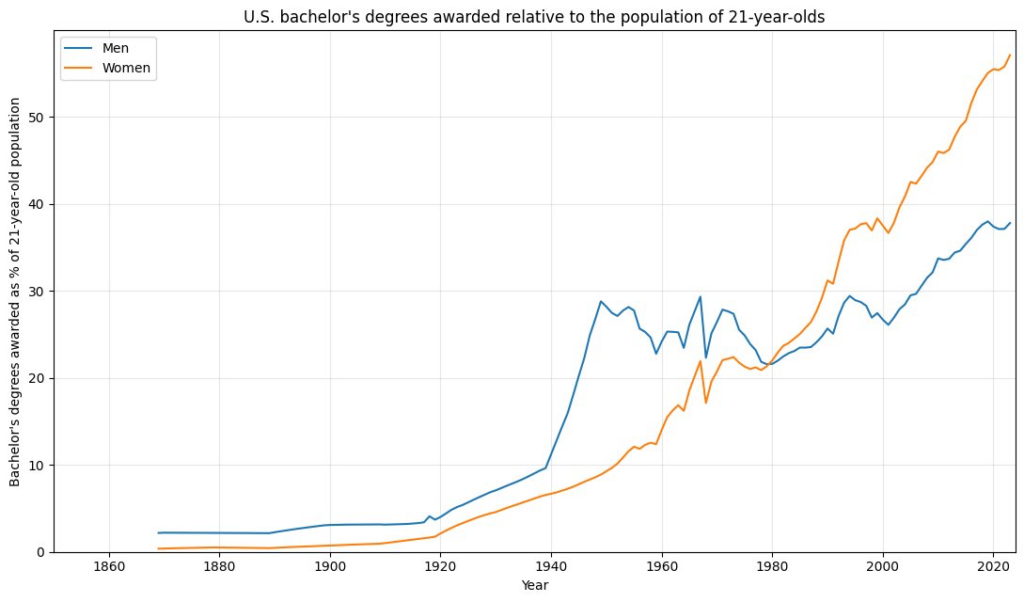
Here are two graphs based on estimates from ChatGPT (which are in line with the Historical Statistics of the United States). The first shows the number of bachelor’s degrees (four-year degrees only) awarded each year, compared to the number of 21-year-olds at the time, for both Men and Women.
The second shows an estimate of the percentage of enrolled undergraduates (not degrees granted) that were men vs. women. I am using enrolled here because it was common, before 1970, for women to drop out of college when they got married.
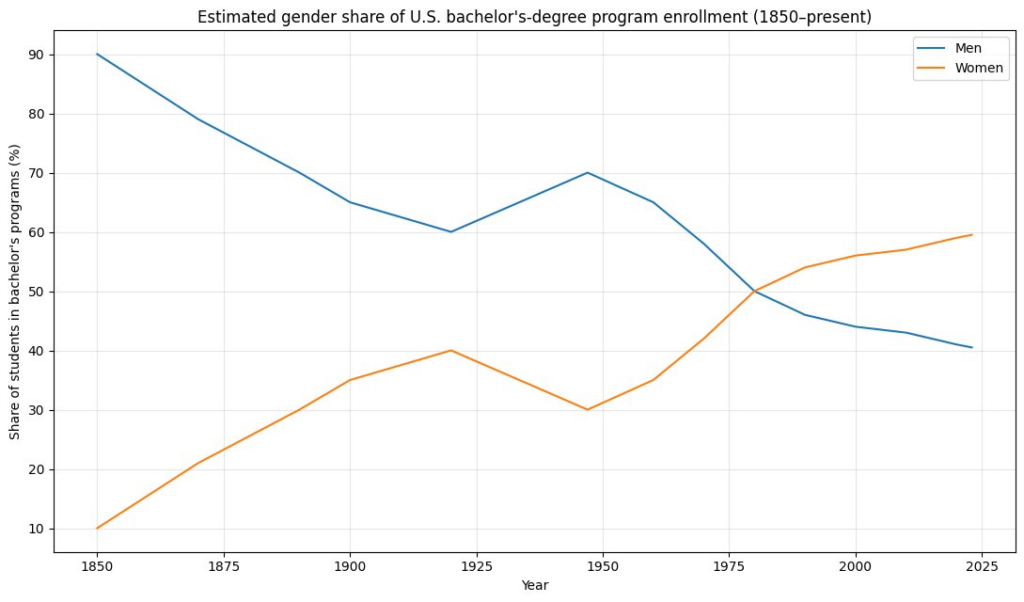
We see that women were about 25% of all undergraduate students in 1875, and 40% in 1925. Pretty high, if you ask me. But, if it got a girl a good husband, and she learned something along the way, it made sense for parents.
Some conclusions here: Less than 5% of men graduated from college before 1920. This rose to about 10% before WW2, before launching higher after 1940. There were probably two reasons for this: one was Fair Labor Standards Act of 1938, which ended full-time employment for youths under 18. As a result, attendance at high school became universal. With so many people graduating from high school, naturally more of them went on to college. Plus, college was probably a good way to stay out of the draft in WW2, or at least, get an officer’s position.
College attendance among men leapt higher after WW2, due to the GI bill and other factors, but then basically flatlined into 2000. The lift beginning around 2004 (of graduates) probably reflects the recession of 2000-2002, when maybe more young people went to college instead. After 2008, a huge expansion in student loans created probably an unsustainable bubble in undergraduate education, that will correct itself eventually.
My take from this is that about 25% of men attending a four-year program is probably about right. Mostly, this would be vocational programs, including STEM or business. The percentage getting a “liberal arts” or “classical” education was always small in the past, under 5%. This seems about right to me today as well. The kind of Liberal Arts (non-vocational) training that I propose would be good for about 5% of the male population, maybe less.
The primary reason why women should attend college, for most of US history, is that it is a good place to find a husband, while also learning about how to educate your own children in the Liberal Arts. The percentage of women who might go this route could be about 10%, compared to 25% college attendance by men. In other words, roughly the situation in 1950. Since this is likely to skew mostly toward Liberal Arts, we might end up with about the same 5% of women studying Liberal Arts in college.