
The general process of a gold standard, or any fixed-value system, is that the money supply contracts when the value of the currency is below the parity, and the money supply expands when the value of the currency is above the parity.
The most basic, and most common, means to achieve this is conversion at the parity. If you offer to either buy or sell gold at $35/oz., then when the currency is above the parity, at $34/oz. (the dollar is worth 1/34th oz. of gold, which is more than 1/35th), then everyone with gold to sell, sells it to the currency manager, who has a bid at $35 when everyone else is at $34. The currency manager buys this gold and creates new money to pay for it, increasing the base money supply.
When the currency is at $36/oz. (1/36th is less than 1/35th), and the currency manager offers to sell at $35, then everyone who wants to buy gold buys it from the currency manager at $35, instead of paying $36. The currency manager sells this gold, receives $35 in payment, and makes this base money disappear. The base money supply contracts.
This is also how stablecoins like Tether work, and also, things like money market funds, or bank deposit accounts — all of which maintain a value fixed to dollars.
June 30, 2019: A Rosetta Stone of “Stablethings”
Although this is what happens in the day-to-day, the result is that base money supply can expand quite a lot, because the currency is reliable and thus people want to hold it. Thus Less Money = More Money. In other words, being willing to support the currency by converting it at the parity price, which reduces base money supply, then leads to increased demand, which then leads to increased money supply.
We see this with Tether:
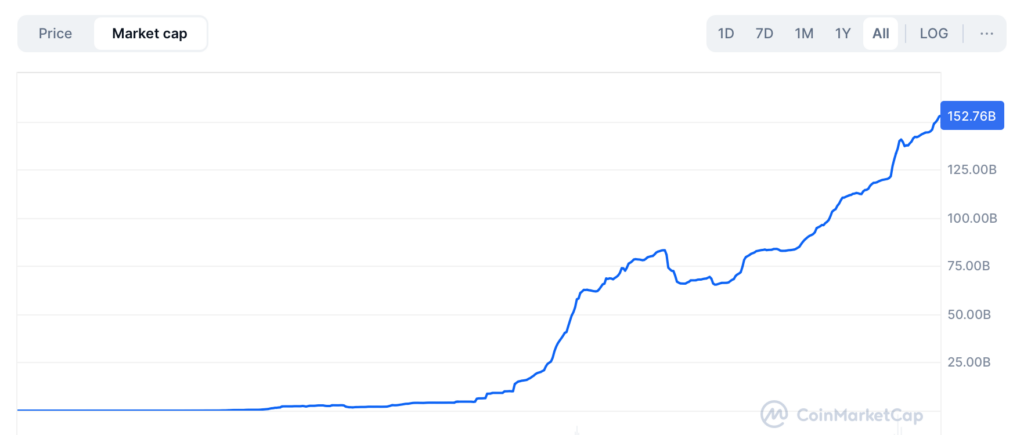
Tether has had a huge expansion of supply, because it is reliable and popular. One reason it is popular is because, even under duress when there was widespread doubt about Tether’s solvency, Tether continually offered to convert USDT to regular dollars (USD), in the process contracting the supply of Tether. You can see this happened a few years ago, when there was a big contraction in USDT supply. This was a “macro scale” event, but the same holds true also in the day-to-day.
On the other hand, a currency that is allowed to fall in value, soon becomes rather unpopular. As it becomes unpopular (demand contracts), its value can fall quite a bit, even though the growth rate of supply is modest, or even negative!
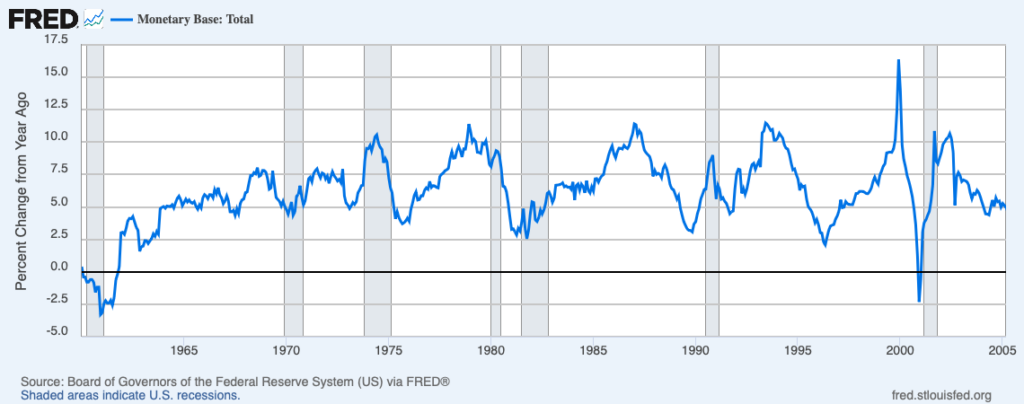
This is what happened in the 1970s. The rate of base money growth was about the same as the Gold Standard 1960s and the disinflationary 1980s. However, the value of the currency crashed about 10:1, going from $35/oz. to $350/oz, in the 1980s and 1990s. It declined again in the 2000s, even though base money growth rates were quite modest.
Thus, it is difficult to say that “X% per year is the right rate of monetary base growth.” Tether has had huge money supply growth, because it is popular. You could have another “coin,” that actually has no supply growth at all (like Bitcoin), and its value crashes because there is nothing supporting it, and it is unpopular.
If you think about this for a little bit, you can start to see why things like “MV=PT” are useless nonsense.
You often hear that “inflation is caused by an increase in the money supply;” or, when this turns out to be false, an “excessive increase in the money supply.” Yes, that can happen. But, what we often see is that a stable and well managed fixed value currency, fixed to gold or maybe USD like Tether, has a fairly high growth rate in base money supply, while a currency that has little monetary base growth at all, or even a contracting money supply, can have a crashing value and monetary inflation. In this case inflation is accompanied by no increase in the money supply at all!
This is more common than most people think. I hav a lot of examples in Gold: The Monetary Polaris:
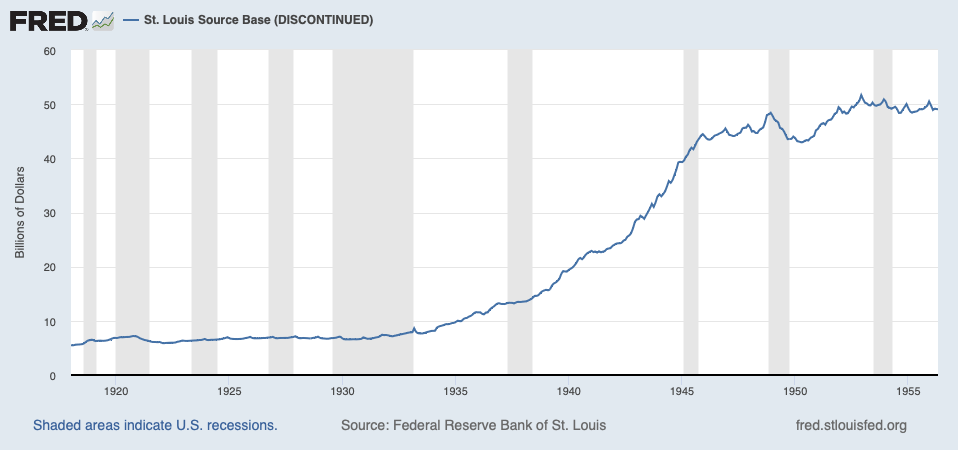
I take the example of the dollar devaluation of 1933. The dollar’s value fell, but base money supply was unchanged.
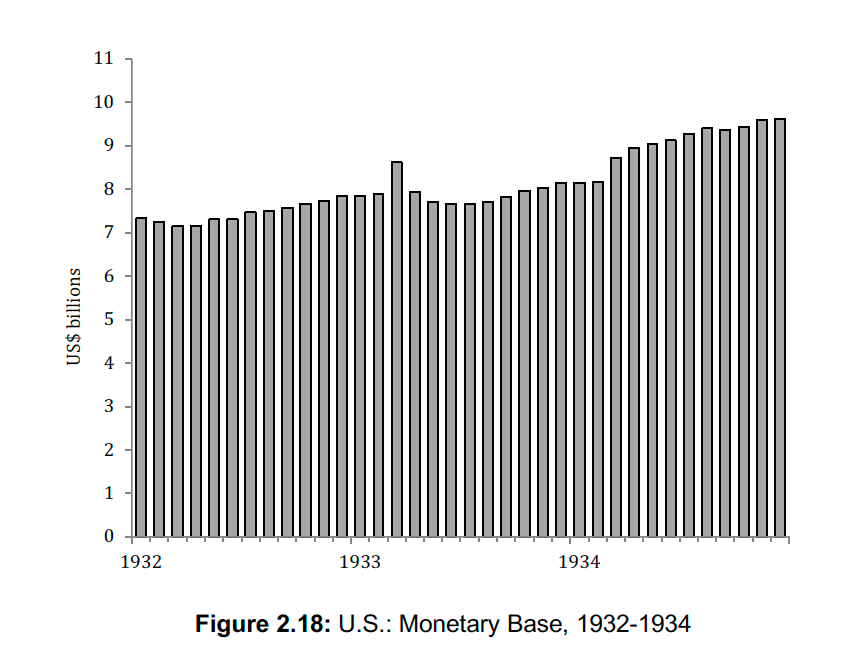
After this, the dollar base money supply grew quite a bit, but the value was unchanged, at $35/oz.
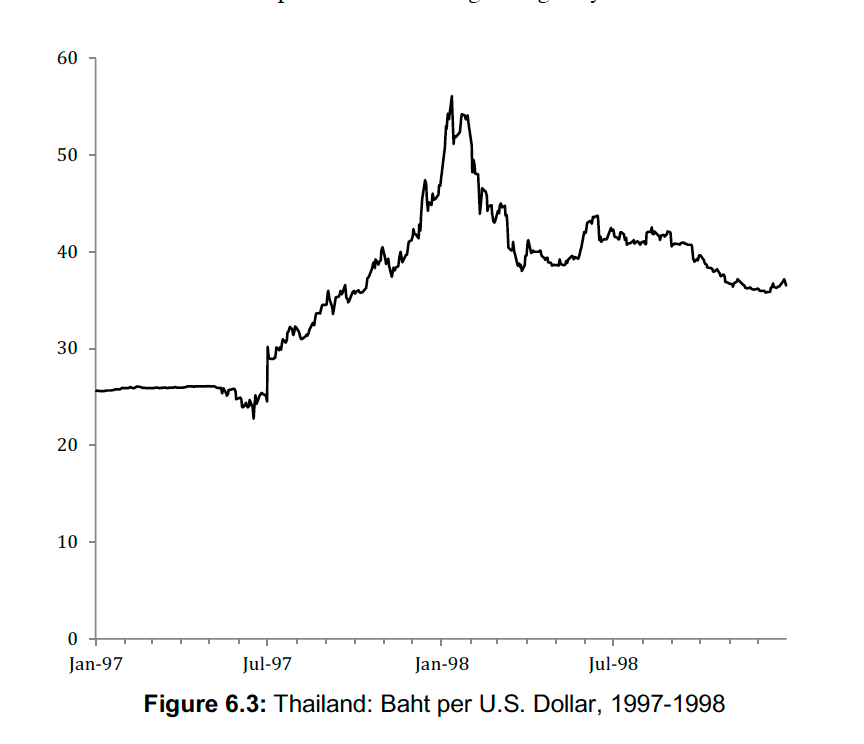
Here, the value of the Thai Baht collapsed.
But, the money supply was unchanged.
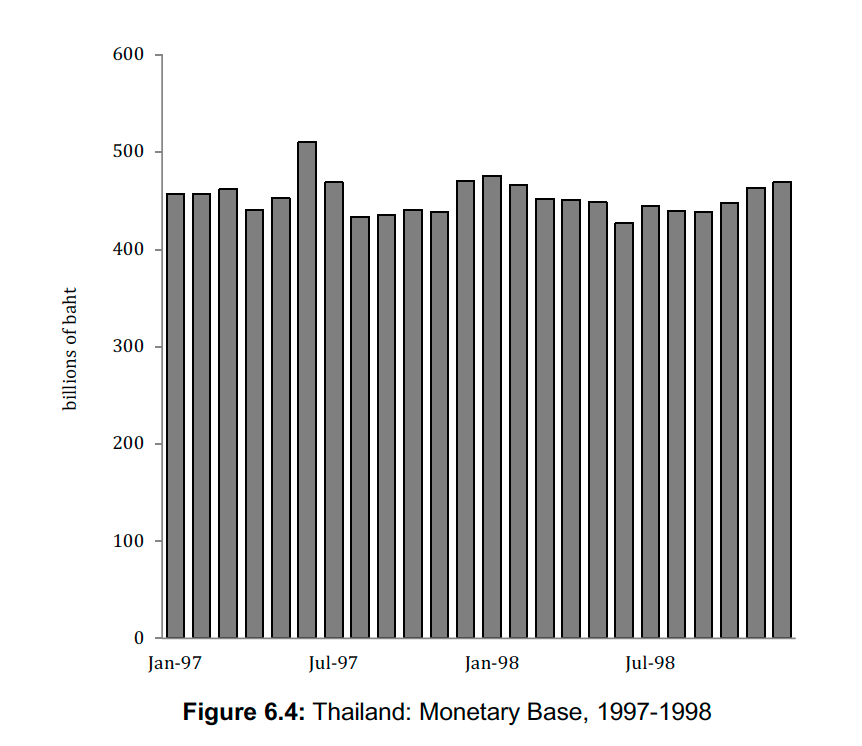
So it turns out that you can have a huge increase in the money supply (Tether recently), but no change in value; and no change in the money supply (USD recently), but a big change in value, causing “monetary inflation.”
Until people are able to get their heads around this, they will continue to spout nonsense that sounds reasonable (greater supply means less value), but is not actually what happens in the real world. Because they are divorced from real-world situations, they will not be able to correctly diagnose what is going on, or offer workable solutions. It is just a sort of fairy tale that they tell each other.