
Here is a ChatGPT estimate of the number of Americans that completed high school in any given year, compared to the number of 20 year olds that year.
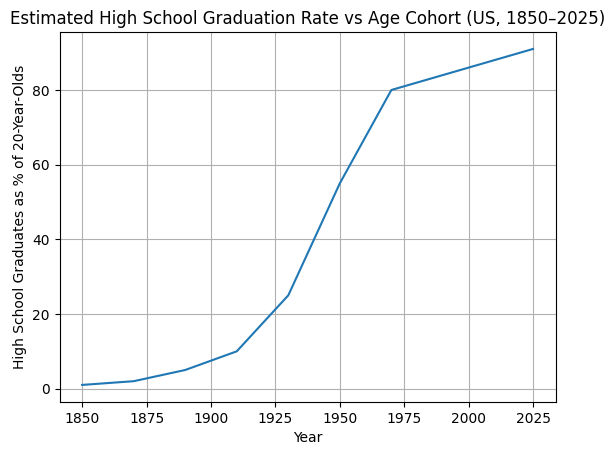
As we see, before 1880 only about 5% of Americans completed high school. They had better things to do. During the early Public School movement in the 1890s, this rises, and rises more in the 1920s. By 1950, following the Fair Labor Standards Act of 1938, which ended full-time work for under-18s, more than half of Americans were finishing High School.
While this might look like Americans were quite uneducated, almost illiterate, actually it was the opposite. This is from the Underground History of American Education.
At the start of WWII millions of men showed up at registration offices to take low-level
academic tests before being inducted. The years of maximum mobilization were 1942
to1944; the fighting force had been mostly schooled in the 1930s, both those inducted
and those turned away. Of the 18 million men were tested, 17,280,000 of them were
judged to have the minimum competence in reading required to be a soldier, a 96 percent
literacy rate. Although this was a 2 percent fall-off from the 98 percent rate among
voluntary military applicants ten years earlier, the dip was so small it didn’t worry
anybody.
WWII was over in 1945. Six years later another war began in Korea. Several million men
were tested for military service but this time 600,000 were rejected. Literacy in the draft
pool had dropped to 81 percent, even though all that was needed to classify a soldier as
literate was fourth- grade reading proficiency. In the few short years from the beginning
of WWII to Korea, a terrifying problem of adult illiteracy had appeared. The Korean War
group received most of its schooling in the 1940s, and it had more years in school with
more professionally trained personnel and more scientifically selected textbooks than the
WWII men, yet it could not read, write, count, speak, or think as well as the earlier, less-
schooled contingent.
A third American war began in the mid-1960s. By its end in 1973 the number of men
found noninductible by reason of inability to read safety instructions, interpret road signs,
decipher orders, and so on—in other words, the number found illiterate—had reached 27
percent of the total pool. Vietnam-era young men had been schooled in the 1950s and the
1960s—much better schooled than either of the two earlier groups—but the 4 percent
illiteracy of 1941 which had transmuted into the 19 percent illiteracy of 1952 had now
had grown into the 27 percent illiteracy of 1970. Not only had the fraction of competent
readers dropped to 73 percent but a substantial chunk of even those were only barely
adequate; they could not keep abreast of developments by reading a newspaper, they
could not read for pleasure, they could not sustain a thought or an argument, they could
not write well enough to manage their own affairs without assistance.
Consider how much more compelling this steady progression of intellectual blindness is
when we track it through army admissions tests rather than college admissions scores and
standardized reading tests, which inflate apparent proficiency by frequently changing the
way the tests are scored.
Looking back, abundant data exist from states like Connecticut and Massachusetts to
show that by 1840 the incidence of complex literacy in the United States was between 93
and 100 percent wherever such a thing mattered. According to the Connecticut census of
1840, only one citizen out of every 579 was illiterate and you probably don’t want to
know, not really, what people in those days considered literate; it’s too embarrassing.
Popular novels of the period give a clue: Last of the Mohicans, published in 1826, sold so
well that a contemporary equivalent would have to move 10 million copies to match it. If
you pick up an uncut version you find yourself in a dense thicket of philosophy, history,
culture, manners, politics, geography, analysis of human motives and actions, all
conveyed in data-rich periodic sentences so formidable only a determined and well-
educated reader can handle it nowadays. Yet in 1818 we were a small-farm nation
without colleges or universities to speak of. Could those simple folk have had more
complex minds than our own?
By 1940, the literacy figure for all states stood at 96 percent for whites, 80 percent for
blacks. Notice that for all the disadvantages blacks labored under, four of five were
nevertheless literate. Six decades later, at the end of the twentieth century, the National
Adult Literacy Survey and the National Assessment of Educational Progress say 40
percent of blacks and 17 percent of whites can’t read at all. Put another way, black
illiteracy doubled, white illiteracy quadrupled. Before you think of anything else in
regard to these numbers, think of this: we spend three to four times as much real money
on schooling as we did sixty years ago, but sixty years ago virtually everyone, black or
white, could read.