
Here we commemorate my big horn system of 2008, which I’ve mentioned many times. Little of it remains except the picture below. Here are the details:
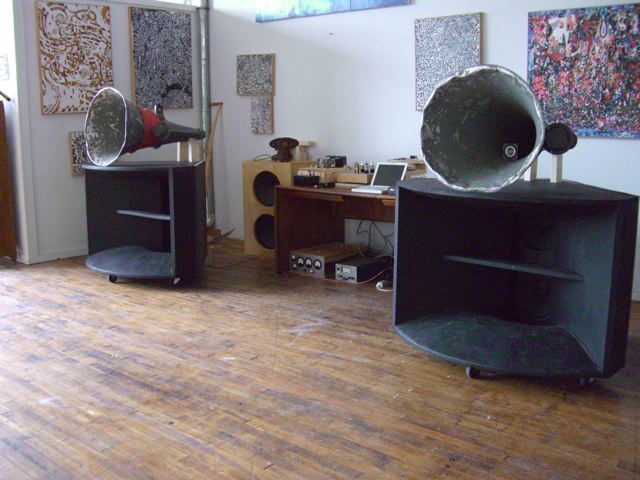
The speakers are:
Fostex FT66H bullet tweeter
Western Electric 720A compression drivers (two per side) in a 5′ long folded horn, with about a 110hz cutoff (quarter size mouth)
RCA “Ubangi” MI-9462 mid/bass horn, with Altec 515E drivers. This is about a 100hz horn with a full-size mouth.
2×15″ Eclipse 8704 subwoofers, in crude car audio boxes
Electronics:
DIYParadise Monica 3 DAC (battery powered), runs from iTunes on a Mac notebook. Used the TDA1545A, a successor to the TDA1543.
Sowter transformer attenuator, 10K:10K. Drives line-level crossover.
Amp 1: Welborne Labs Moondog 2A3. 3 watts, on horns.
Amp 2: DIYParadise Charlize (battery powered). TA2020 Tripath-based, for RCA woofers. Made about 6 watts into a 16 ohm load.
Amp 3: SAE DM-Mark IV. 1980s, 100W solid-state, used with subwoofers
Passive line-level crossover on horns, 250hz Butterworth 3rd order.
Passive speaker-level crossover (a single cap) on the bullet tweeters, around 5000 hz
Active analog crossover on woofers and subwoofers, probably Behringer CX3400.
Active parametric equalizer on subwoofers, probably Behringer PEQ305
There were also versions that used my 01A-71A line/headphone amp, to drive the passive crossovers, and a 10Y/45 amp to drive the horns. You can see them on the desk in the picture, to the left. These were powered by a stack of 12V batteries to make 300V, which is in the box on the floor, with an industrial power supply next to it as a charger. This was problematic, since the old and decrepit variable-voltage industrial power supply was unreliable, and batteries need rather precise voltage to charge properly, accurate within a tenth of a volt. I was inspired by two things: First, battery power was actually common in the early days of tubes, when these 01As and 71As were going into the first generation of consumer radios in the 1920s. A lot of people didn’t have regular electricity, but they still wanted to listen to the radio. We still call the main power supply “B+” because it was literally the positive end of the Battery. Second, people were experimenting with battery power in the 2000s, and reported good results. I might go back to battery power at some point. Use stacks of four 12V batteries for 48V, and use a 55.2V fixed-voltage float charger, which can be shared among batteries. I used a stack of 4PDT relays in the past, but today I would go with a simple manual 4PDT switch for charging.
The midrange horn and the RCA bass bins were both around 108-110db. The bass bins were really wonderful. You could sense a LOT of air being moved, easily filling a huge space like a theater or my factory space, which could eat up 15″ box woofers like Pringles. I also tried some RCA 9595 radial horns with 9584 drivers here, the original equipment paired with these bass bins. These are 200hz exponential, typically crossed around 300hz. This was not good at all. The 9584 drivers are quite famous for sounding good (and I love them used with conicals on OMA’s AC1 speaker), so I blame the horns, and their convoluted throat sections. The subwoofers were barely a little crude infill. They improved a lot when put in proper boxes, with big power. Putting the tweeters inside the horns helped with coherence, although I probably wouldn’t do it again. Overall, despite not being very refined, this sounded great.
The RCA bass bins were sold when I had to move out of the big factory space. The Western drivers and horns became part of the 2015 system, and then were later sold, along with the line-level crossover. The Eclipse subs got new boxes, became part of the 2015 system, and are now part of the 2026 system. The Fostex bullet tweeters also became part of the 2015 system. The Moondog amps were part of the 2015 system, and were later sold. The SAE amp died and went to amplifier heaven. The 300V battery power supply fizzled after the charger went goofy, and the lead-acid batteries were recycled. The DIYParadise DAC was sold, replaced by a Metrum unit for the 2015 system. The DIYParadise Charlize amplifier was sold, and its battery power supply was recycled. The Behringer crossover and equalizer were sold. The 71A headphone/preamp had several rebuilds, but has been dormant since its battery power supply died some time ago (more charging problems, don’t use variable voltage supplies). The 10Y-45 amp was disassembled, and the Electraprint output transformers were sold. The Lundahl 1660 interstage transformers are still here, to be used in a future project. The Sowter transformer attenuators are still here, but unused in favor of a 600 ohm autoformer from Dave Slagle, which works better with headphones. The Sowter units will probably get use again when the 71A amp is revived.