
You probably perceived that my inclinations in Audio tend toward the 1998-2005 period, a formative time when big horns, single-ended DHTs and LM-series Chip Amps were the object of collective attention. Much of what I am doing now is simply realizing my ambitions formed around that time, which is now twenty or more years ago.
Didn’t something important or useful happen since then? Is this still the best we can do?
This era passed basically because of three things: First, the transistor amp manufacturers, embarrassed by the superiority of dirt-cheap Chip Amps, or expensive 300B SETs, actually made some improvements. Second, Class D came on the scene, and has been through three or four generations of improvements since then. Recently, Analog Class D (“pulse wave modulated” or PWM) has been supplemented with what amounts to Digital Class D, in the GanFET “Power DAC” amps. We also now have GanFET linear amplifiers, which are apparently pretty good. Third, big high-efficiency horn systems, even something living-room friendly like a Klipsch Cornwall, didn’t catch on among the general audiophile public. You could have had very small horn-loaded speakers too, like a 6″ coaxial, but people loved the “imaging and soundstage” of their teeny dome tweeters.
But when we draw a line under all this, what do we find? We find that Class D has been able to provide enormous amounts of power (commonly 300W+) that’s cheap and also pretty darn good. Maybe not at the highest sound quality levels, but very good value. The same applies to the Power DAC genre of amplifiers. Big power, not too expensive, sound great. I don’t know if they sound better than my $1.58 chip amps, but they should. Conventional Class AB transistor amplifiers got a lot better sounding while still delivering big power.
The problem is, I don’t need huge power. As you can see, the horns really don’t use anything more than 10W in a multiamp setup; and a lot of amplifiers that sound great at 10 watts don’t necessarily sound good at 10 milliwatts, or 0.1 milliwatts. A lot of amplifiers that people listen to at 10W, actually don’t sound that great at 10W, but you can’t tell easily because low-efficiency drivers and passive crossovers smooth off the corners and dampen the response. The woofers on my Yorkville U215s could certainly use big power (don’t need it but why not?), but since they only go to 300hz nothing particularly refined is needed here. A Behringer A800 power amp, $229 and 400W per channel into 4 ohms (Class D), would be perfectly fine.
The woofers on the U215 are around 98db, for the pair, 4 ohms. They would need 100W to hit a 118db peak, which is about what we would like here. Basically, that would be a +25db peak above perhaps a 93db average level, which is the sort of thing that really happens in something like the 1812 Overture, when the cannons come in. The 113db/W compression drivers would, nominally, require about +5db to match the woofers at 118db. +5 db is about 3 watts. But, since most of the action is happening in the bass, in practice, when the speaker as a whole is hitting a 118db transient, the tweeter is probably doing around 1 watt or less. Even your 45 DHT would be hardly breaking a sweat. There is constant-directivity EQ on the tweeter, boosting the upper frequencies by as much as +14db, which does take more power. But also, there isn’t really that much going on above 8khz, so it doesn’t take much power even when boosted +14db. Anyway, the woofers are rated to 1600 watts, so why not have 400 watts on them, even if you don’t and shouldn’t use it?
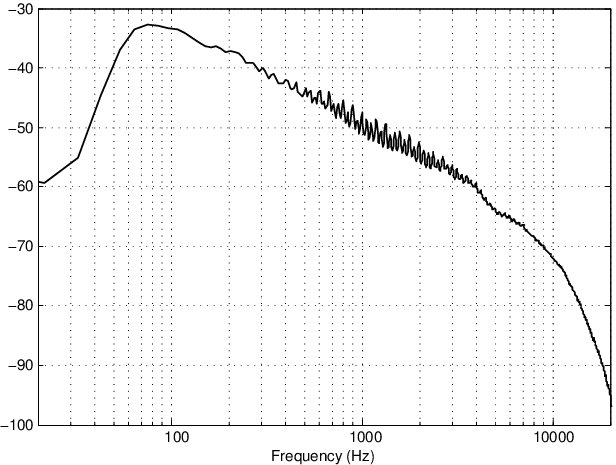
This is a graph of generic distribution of power vs. frequency in music. Obviously, it depends on the music. An acoustic guitar and female voice will have almost nothing below 100hz. Your drums and bass music will be very heavy below 200hz. A full orchestra can play very loud, but again there is not so much going on below 100hz. If we use this generic representation, we find that there is a lot going on between about 50hz and 300hz, averaging let’s say -35db (from peak) on this chart. At 2000hz, we are around -55db. That’s a 20db difference, or 100:1. So, for typical music, the amount of raw sonic energy being produced at 100hz is about 100x more than at 2000hz. Now if your compression driver has a 10db advantage to the woofer (108db vs 98db), that turns into a 1000x difference in electrical power needed. In other words, you can put a 400 watt amp on the woofer and a 1 watt amp on the tweeter, to play the same music together, and both will max out at about the same time.
I currently have about 250W per channel on the subs, which are only about 87db efficient. In practice, the subs will max out long before anything else, around 100db; not that I ever hit those levels anyway. This is how these are used in prosound: the U215s are top boxes, and then you add as many subs as you need to fill your venue, the subs being the primary limiting factor. My tiny room, although it is bad for bass in general, does provide significant room gain below 40hz. The room gain at 20hz is about +10db, which almost exactly matches the falloff from the sealed woofer below 40hz, resulting in an almost flat response believe it or not.
The next big advance was pretty good multichannel digital processors/DACs, such as the eight-channel unit I’m using from MiniDSP, and which costs about $600. This goes from a digital USB input direct to eight channels, with abundant processing (now including FIR) on deck. Unlike predecessors like the Behringer DCX24/96, the outputs on this sound pretty good. Not as good as the best DACs, but good enough for serious use. In the 2000s, the analog “passive line-level crossover” was the norm, and I used one for my 2008 and 2015 systems. A digital crossover usually used analog inputs, so you would go from digital to analog in a DAC, then from analog back to digital, then from digital back to analog — stacking up processing latency along the way. Blech. I did this in the 2015 system, but only for undemanding functions such as a subwoofer crossover. The 2008 system used an analog prosound crossover from Behringer, again only tolerable for subwoofer duties.
Not just multichannel digital processing. In the 2000s, “no oversampling” R2R DACs were an exotic rarity, revived by 47 Labs, the same guys who also used the LM3875 in an audiophile product. They used an antique from the earliest days of digital-analog conversion in the 1980s, the TDA1543. Instead of the “delta-sigma” DACs that were the norm by then, this used the most primitive form of resistor-ladder conversion. This was a little like going back to carburetors after decades of computerized fuel injection. But, it sounded better. Since then, several generations of R2R designs followed, such that it is now quite common among higher-end DACs. In the 2000s, a good vinyl setup was still notably different, and better in many ways, than common digital. The combination of good vinyl and better DACs lit a fire under the digital people, and they too upped their game since then. Now with 24/96 streaming and quality R2R DACs everywhere (that sound a lot better than the old TDA1543 which I too owned and used), vinyl can still be different but it is not so obviously better than before. The cheaper end of the spectrum also caught up, such that you can get pretty good digital sound for under $300, as you find in the outputs of the Flex 8. (It uses two ESS Sabre 9080Q. From its inception, the Sabre series has been known to offer many of the sound quality advantages of R2R, with many of the signal-processing advantages of delta-sigma design. After several generations of development, they’ve become pretty good.)
If you are wondering, the 32-bit internal processing on the MiniDSP Flex 8, combined with dithering, renders a very good volume control that does not suffer from loss of resolution at low levels — even the millivolt levels that I commonly have, -70db or more from maximum output on the channels feeding the compression drivers. Just to give an idea, 0.05V rms measured at the speaker terminals translates to about 2mV rms signal input. This is a little goofy, and I am looking forward to experimenting with vacuum tube amplifiers with much lower gain, perhaps around 2x. So, you would have about 25mV input and 50mV output; with peaks of perhaps +20db, which would be 250mV input and 500mV output.
So what we have today, that we didn’t have in the past, is big power that is cheap and sounds good, and digital that is cheap and sounds good, plus a lot better digital signal processing. I am using both.
We have also had advances in horn technology, as the conical expansions that have been common in prosound since the 1980s have been refined for home use. A lot of this has to do with the fact that it is simply hard to swap horns around, so audiophiles have been very slow about this. Also, all constant-directivity horns require equalization, which makes for complicated passive or active crossovers. Around 2005, most audiophiles stuck with vintage multicells or radials — in part because they were cheap and plentiful, and required only simple active or passive crossovers — while we occasionally listened to presentations by Bill Woods on the virtues of conicals. Since then, a lot of popularization by Woods, Earl Geddes and others have brought more conicals into the home, mostly in the form of “waveguides” which typically are the same thing but with a little throat transition, and maybe a little rolloff on the mouth. Now you can buy conical “waveguides” for hardly anything at all, while in the past this kind of thing required fabrication by hand. Nearly all the plug-and-play options are for 1″ exit drivers, while 2″ exit drivers are still neglected, except for some options aimed mostly at prosound and car audio. Also, audiophile lore (mostly uninformed by any actual experience) has always put great emphasis on some kind of ingenious smooth complex curve, like a Tractrix or Le Cleach, and finds it revolting that something as simple as a conical can actually work well. But, in audio, simpler is usually better, and in this case it means straight sides are better than complex curves. There is a certain kind of obvious distortion from complex curves (exponential or tractrix) that Bill Woods would show us, that I don’t think turns up in frequency response. Plus, these kinds of horns are typically very beamy, which is extremely unnatural and one big and real reason why many don’t like horns. The development of super-flexible digital crossovers has also made constant-directivity equalization realistic for the home hobbyist. Today, Klipsch itself, the inventor of the Tractrix curve, uses modified conicals, with straight sides that probably provide most of the advantages of constant directivity, and a kind of bulge in the corners that produces more of a Tractrix expansion. For the big Jubilee, it’s a plain conical, here used with digital equalization.
Meanwhile, American Audiophilia has contracted even more into a tiny circle around mostly little two-way standmount speakers, or maybe a little tower if you are ambitious. They aren’t doing anything that I am interested in, so it is of little use to me. Today’s shoebox speakers are not meaningfully different from those of the 1980s, except perhaps in the recent trend toward active speakers with onboard DSP.
There are other modalities, besides the big horn/multiamp path that I have taken, that can benefit from recent developments. The Magnepan LRS+ is reportedly a magnificent speaker, at a low price and appropriate for small rooms. But, it takes big power into low impedences. One of those new GanFET digital amplifiers seems like just the thing. For $3000 you could have a brilliant setup running. Magnepans have been around forever, so this is nothing new, but it has evolved in a positive direction over the years and the newest offerings are very good.
Headphones radically expanded in popularity, especially among younger people. People got used to using headphones from the earbud/iPod/iPhone days, 2005-2015. Then they started looking for better alternatives. Now there are a ton of good headphones out there. But, headphones are a pretty simple thing, and I still say the 1990s-era Sennheiser HD600-series cans are a reference for good sound that you can get for under $300. Headphones are still my “daily driver” while the speakers are more of a weekend ride.
Another thing is that I like to build things. I can build a Chip Amp, and I can build a DHT vacuum tube amplifier. I can’t build a GanFET Power DAC. If I wasn’t able to expend my hobby energy building things, I might be tempted to spend $500 on a cable. And what’s the fun in that?
25 years ago, people thought the LM-series Chip Amps were pretty hot stuff. Even people who were actually owners of the legendary Audio Note Ongaku (and also Herb Reichert, Audio Note’s US distributor), said that they were pretty good. But, maybe we were swayed by the novelty factor, amazed that something could sound good that cost $1.58 and was as big as a fingernail, even if it wasn’t actually that great. People also professed their amazement at the early Tripath Class D amplifiers, which didn’t actually sound very good. (I owned two of the products mentioned in this review.) Today, maybe things have moved on. But, hardly anyone used battery power on them in those days, so maybe they will be even better. Not only can I build them myself, but I can actually do something significant with it that you can’t buy in stores. Anyway, it is fun to build and now I can compare to other alternatives side-by-side. Much the same applies to the DHT-type amplifier. Eventually (it will be years down the road although I already have some of the parts, including most of the tubes and transformers), I will build out a 26-10Y-300B amplifier using good iron from Lundahl. Basically, it would be a lot like the stuff that Thomas Mayer builds. Here, the advantage is that it doesn’t cost me $60,000. Maybe you can buy it in a store, but I can’t. These DHT amplifiers are still popular in the megabuck class. Plus, the satisfaction of building it yourself. DHT amplifiers are sort-of plentiful now but these kinds of exotic products remain very, very rare.