
It took a while — six years since I bought the Yorkville U215s used from a dance club in Lower Manhattan — but I finally got around to multiamping them with the LM1875-based “chip amps” that I finished last year.
And …
It’s fantastic! I was prepared to accept that, after all this effort, maybe the result wouldn’t be much better, or no better at all, than the passive crossovers that Bill Woods designed for these speakers. And indeed I had one speaker multiamped, and the other still with its passive crossovers, both driven by the LM1875 amplifier, side by side, and they didn’t seem that much different.
They didn’t “sound” that much different, because both had the same drivers and cabinets, and both had about a flat frequency response, so why would there be any difference?
So I multiamped the other one as well, and did a fair amount of careful adjustment to the crossover and also constant-directivity EQ (all in the digital realm), using a test microphone and Room Equalization Wizard, some free software on my Mac notebook. This additional careful adjusting helped a lot. The result was exactly as I hoped for — a kind of ease and expressive tonality that I remember from every time I multiamped compression drivers in the past, and which was notably missing from the passive version. It’s been 12 years since I’ve had a multiamped horn system up and running, and I think I still like it.
In some ways it was almost the same, and in other ways it is so much different, that I would say that it is 3x better. It was not an incremental improvement, it was a huge leap from “Why bother?” to “This is awesome.” If I were to put it on a scale of 1-100, I give the passive version a 50 and the new version an 80. The new amplifiers also helped, notably better than what I was using before.
Here’s how they look in my tiny 10×12 room:
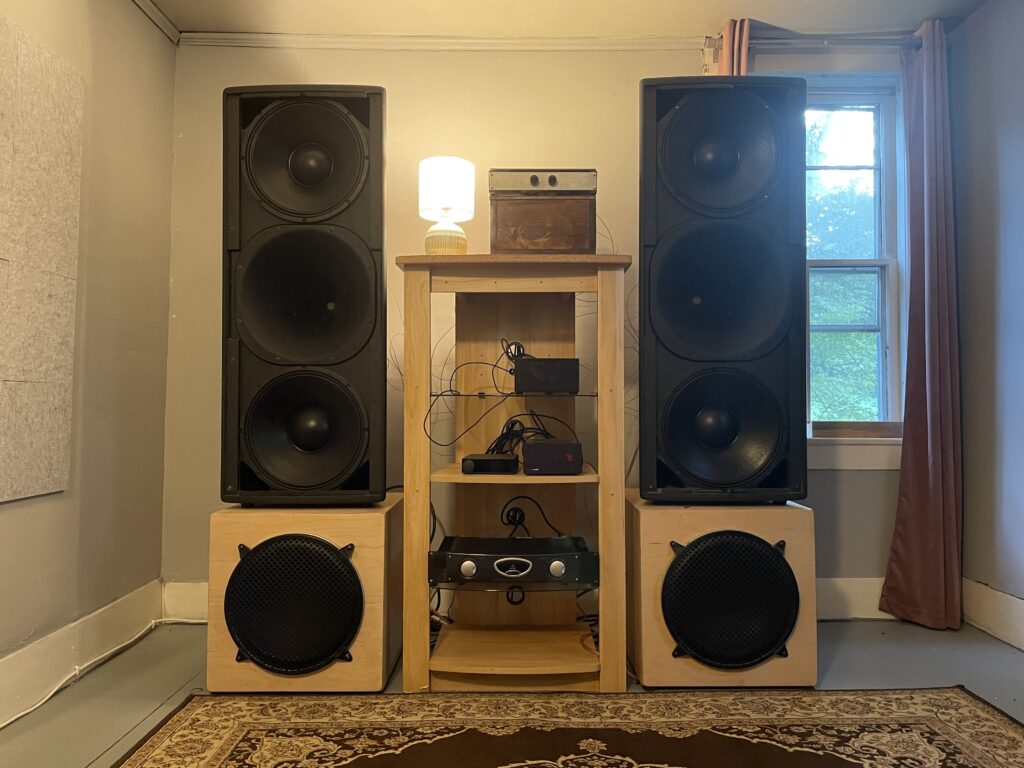
In general, small rooms sound bad; and usually worse when you try to fit six fifteen-inch woofers in them. It’s what most people say you definitely shouldn’t do. Room treatments are a mandatory; but, even as it stands now, the results are pretty good. There is a -4db shelf at 300hz to compensate for wall bounce, originally from using the passive crossovers. This is theoretical now since I adjusted the woofer level by microphone measurement anyway. Also, the subwoofers are set much lower than is suggested by microphone measurements, probably about 7db down, using the adjustable front volume knobs. I tried it as-measured and the results were ridiculously bottom-heavy. Measurements don’t really work well below about 200hz. They pick up a lot of room nodes and bounce, which isn’t really what you hear. If you don’t have all this EQ available, this small room and close-to-wall positioning would definitely sound bad. There is still a ton of bass. Kick drums sound fantastic, even at low volume levels, because having 4x 15″ woofers is basically a lot like a kick drum or tympani, a round diaphragm of roughly the same surface area. It’s very different than a 6″ cone.
In general, woofers behave pretty much as modeled below 200hz, so the standard methodology is to measure response above 200hz and then use the modeled output as a guide below 200hz, rather than using microphone measurements which will look very ugly and useless unless you are in a specially-treated anechoic chamber.
I was wondering if I could tolerate the LM1875 “chip amps” in this most-difficult-of-all job of directly driving 1″ compression drivers, about the most revealing thing you can do to an amplifier. This is not only “first watt” territory, but first milliwatt. With the speaker playing pretty loud (let’s say 85 db average at the listening position), I was measuring 0.05 volts at the speaker terminals, which works out to 0.3 milliwatts. There are a lot of amplifiers that don’t sound good at all at 0.3 milliwatts, especially when you remove all the passive crossover stuff that prevents you from hearing how bad it sounds.
These compression drivers are rated at 113db/W, which also means 83db at 1mW. -30db is equal to 1/1000. However, since they are crossed at 1200hz and only have to reproduce the top end, they have much lower power demands even if the speaker as a whole is playing at 83db. In a small room, the listener is not that far from the speakers, plus there are two speakers playing implying +3db, plus a lot of room reflection. In a larger 20×25 room, or 4x the floor area, you might be sitting twice as far and there would be less room reflection, resulting in about 2-4x the power needs for the same sound pressure level at the listening position.
As expected, the LM1875 amplifiers have a very “glass, aluminum and vodka martini” tonality, not the “wood, leather and red wine” tonality common with 1930s-era DHTs done well. These amplifiers can do megahertz bandwith, and it sounds that way. It would be very easy for them to drift into “broken glass and crumpled aluminum foil” tonality, as many transistor amplifiers do when faced with this kind of task, but they don’t. They sing wonderfully. Clean, quiet battery power is easy to implement with these little chip amps, but hardly anyone does it.
The digital DAC/processor is the MiniDSP Flex-8. You just attach a digital source. I like my iPhone, using a USB cable. Later, I will try to add FIR filters to fix impulse response, probably using DIRAC (some software that’s not free). Also, I will eventually try the 6DN7 push-pull tube amplifiers that I built especially for this task, to see if they do the first milliwatt even better than the LM1875. But before then, I think I will experiment with the LM4780, which I think is the last of this series. The LM1875 was the little brother of the LM3875; the LM3886 “Overture” was the successor to the LM3875; and the LM4780 is two LM3886 amplifiers in a single package. I got a kit with PCBs from Peter Daniel of AudioSector, who did a lot of work with these 20 years ago. He told me it was his last kit.
The LM1875 has substantially higher measured THD distortion than the LM3875, but nevertheless many prefer it. The LM3875 is known to be somewhat poor on 4-ohm loads, and the LM3886 is better. They also sound a little different, with some preferring the LM3875. Anyway, it shouldn’t be hard to build these out. I want a better amplifier for the woofers anyway, and the LM4780 should work very well here. For now, I am using an LM3875-based amplifier with the usual transformer power supply on the (4-ohm) woofers. It has noticeable 60hz hum, which is irritating, plus I think the battery-powered LM1875s sound substantially better.
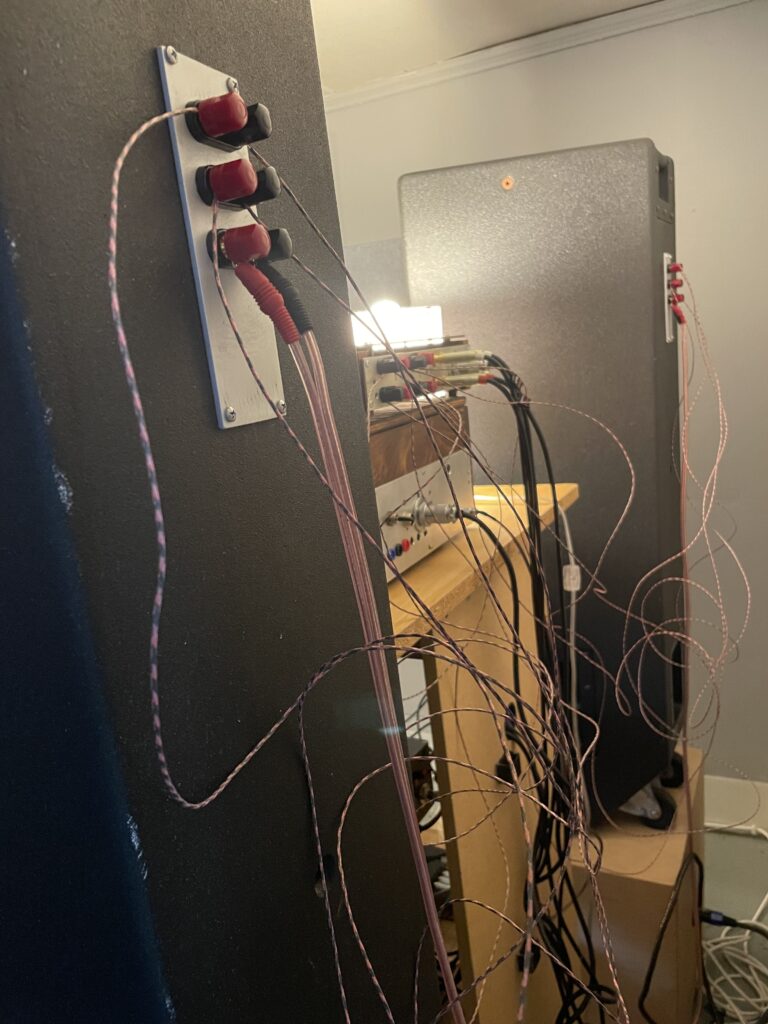
Speaker cables are some 24ga cloth-insulated vintage telephone wire from Western Electric (Bell Telephone), probably 1940s-era, which I’ve had around here a long time. Cool. You can buy some for a few bucks on EBay. There’s a whole “narrow gage magnet wire” thing to go with multiamping compression drivers. Steve Schell, designer of the Cogent DS-1428 compression driver, used 26ga magnet wire for years. (If you don’t know what this is, it is 0.46mm in diameter, 0.16mm2 in cross-sectional area, and is sold in rolls of 1263 feet.) Anyway, the wire in your tube output transformers, and the wire in your speaker coils, is magnet wire too. I was using some 30ga magnet wire for a while, a long time ago (0.07mm2 in area), and it was noticeably different and better than big wire. This is spiderweb stuff. Don’t wave your arms around too much. My internal wiring is 22ga solid-core hookup wire. There is some 12ga cable for the woofers. I found out that the original internal wire for the woofers was around 20ga, which seemed pretty skimpy for a box rated to 1600 watts, although it is probably no thinner than the voice coil wire or the hundreds of feet of magnet wire in the passive crossover inductors. These got 12ga on the inside too.
Plus, while the usual audiophools are yammering about superexpensive wire, it’s fun to use something that dates from when the Marx Brothers were hot stuff.
Of course you can also use the 24ga solid-core twisted pair copper found in Cat5 network cable. This is so cheap it’s almost free. Here is 500ft, which includes four twisted pairs, for $80.
Here’s the view from the rear:
I looked up the woofers used in the U215, and it appears to be the 18Sound 15ND930, a rather nice neo-magnet woofer. Using their TS parameters, I found an optimized reflex enclosure (i.e., lowest possible bass) with a -3db point at 87hz — surprisingly high to me, but I think common in this use. (This is because Qts=0.22.) The optimized enclosure volume is right about what you have with these speakers, so I assume it is an optimized alignment. Yorkville claims -3db at 45hz, and these might be OEM with different TS parameters. But, the enclosures are still very small, and the Iron Law of bass is that you can have high efficiency (yes), small enclosure (yes), or deep bass response, but only two out of the three. These are really top boxes, with hardly any low bass at all. This is to allow a tolerably small and transportable/flyable cabinet, high efficiency, plus enormous output power since the woofers are relieved from low bass duties — all desirable points in the prosound world. The Yorkville-recommended crossover to the subs at 100hz makes sense now. An optimized Q=0.707 sealed enclosure (lowest possible -3db point) would have a -3db point at 115hz, so it doesn’t really work for sealed at all. I was playing with using a crudely-sealed enclosure by stuffing the ports with towels, but I took these out.
The compression driver is a BMS 4550, a nice item, and the midrange cones are sealed-back units from Celestion. Normally they are wired in parallel for 2.67 ohms (8/3), which is integrated into the passive crossover to present an 8-ohm load. Here they are in series for 24 ohms, very tube friendly, and also fine with solid state. A 24-ohm load effectively reduces the output power of the LM1875 from 25 watts@8 ohms to about 25/3=8 watts, which is irrelevant since we are again in the milliwatt range on these too.