
Here is a very interesting graph sent by a friend of mine, with full sourcing:
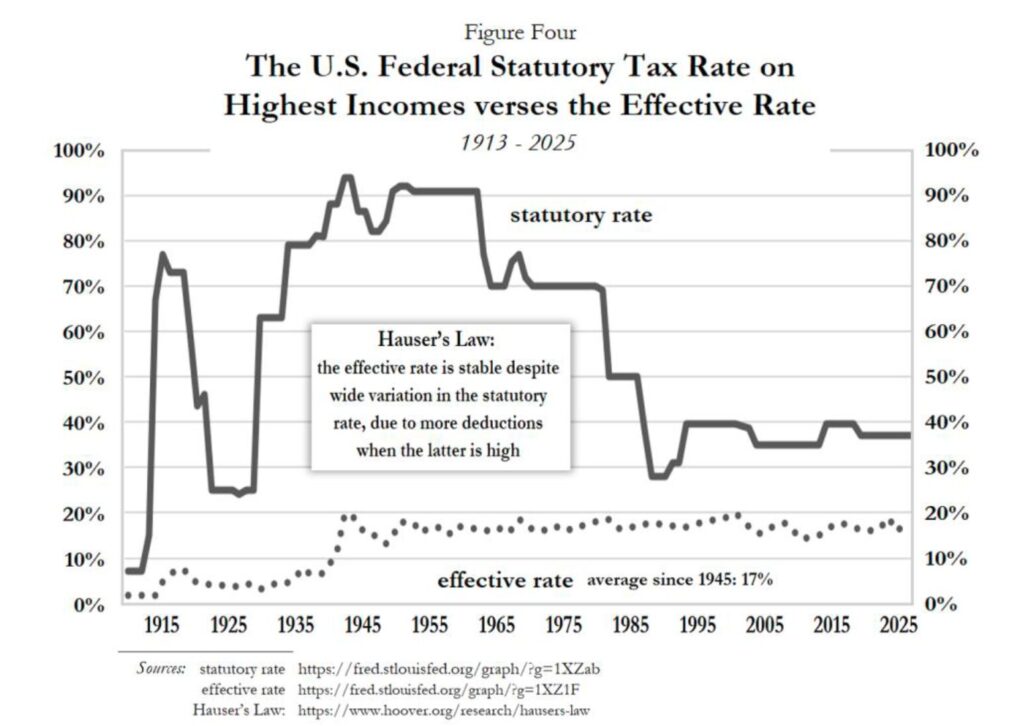
Here is a link to the report (by David Ranson) at the Hoover Institute:
Among other things, this shows an approriate Flat Tax rate — the rate that applies when you eliminate all the deductions and other stuff. 17%.
Personally, I would rather have a 17% VAT. But, that would require eliminating the Income Tax entirely, including the 16th Amendment. We don’t want to have a VAT and an Income Tax together. That is, of course, a higher political hurdle. But if we want it we can have it, and President Trump clearly wants it. So instead of considering it “a problem,” we can consider it “a solution,” of how to get rid of the Income Tax effectively.
Actually, the corresponding VAT rate would be somewhat lower, since it effectively applies to all employee compensation, not just wage income. Also, it has no basic deductible, like most Flat Tax proposals.
The payees of a Value Added Tax are businesses, not individuals. (Self-employed file as businesses.) The tax base is Value Added, big surprise. The US Economy has Gross Value Added of about $24 trillion. So, the VAT that would replace all current Individual and Corporate Income Tax Revenue is about 13.3%. There would still be payroll taxes, in this model.
I think there should be a basic de minimus exemption in the VAT, if it were really implemented. There are a lot of people who make a little money here and there, selling some tomatoes they grew in their backyard or building a deck for a friend. Basically, they are “self-employed” with this little side project. To relieve them of the burden of filing taxes, you could just have a postcard filing that declares that value-added was below some number, let’s say $20,000. Then they wouldn’t have a legal liability when they don’t declare that they made $546 in value-added selling handmade pottery.